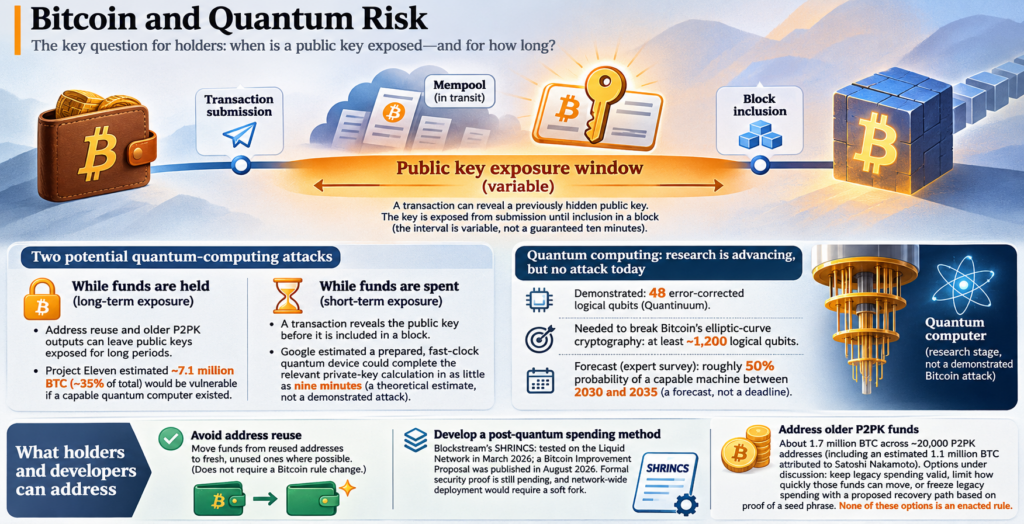
For Bitcoin holders, the practical question is whether a public key is already exposed—and what happens when a transaction reveals one. In a report published on November 12, 2026, the Bitcoin Security Consortium, working with Presidio Bitcoin, described two potential quantum-computing attacks. It also stressed that no cryptographically relevant quantum computer had been demonstrated.
Two ways a key could be exposed
A sufficiently capable quantum computer running Shor’s algorithm could, in theory, derive a Bitcoin private key from its public key. The report distinguishes between two opportunities to do so:
- While funds are held: Address reuse and older pay-to-public-key (P2PK) outputs can leave public keys exposed for long periods. Project Eleven estimated that about 7.1 million BTC, or roughly 35% of the total, would be vulnerable to theft if a capable quantum computer existed at the time of the report. The consortium said roughly three-quarters of that estimate was held at reused addresses, largely associated with major exchanges. It also cited approximately 1.8 million BTC in P2PK outputs, much of it presumed lost and therefore potentially difficult to move.
- While funds are spent: A transaction can reveal a previously hidden public key before it is included in a block. The exposure lasts from submission to inclusion—not a guaranteed ten minutes. Google estimated that a hypothetical, prepared fast-clock quantum device could complete the relevant private-key calculation in as little as nine minutes. That is a theoretical estimate, not a demonstrated Bitcoin attack.
Most active funds in the modern output types described by the report do not have an exposed public key before spending. That distinction matters: the long-term exposure of a reused address is different from the shorter window created by a transaction.

Why the research matters—but is not an attack today
The report pointed to advances in error correction and proposed optimizations of Shor’s algorithm. It also drew a firm line between research designs and working machines. It said Quantinuum had demonstrated 48 error-corrected logical qubits, while breaking Bitcoin’s elliptic-curve cryptography would require at least about 1,200. The cited 2026 circuit designs were blueprints, not demonstrations of computers breaking Bitcoin keys.
Uncertainty cuts both ways. The report cited an expert survey assigning roughly a 50% probability to a capable machine emerging between 2030 and 2035; that is a forecast, not a deadline or a confirmed capability.
What holders and developers can address
The report’s most immediate holding practice is to avoid reusing addresses and move funds from reused addresses to fresh, unused ones where the holder can do so safely. It said this does not require a Bitcoin rule change. Moving funds, however, does not remove the separate exposure window during a future spend.
A longer-term response would require a post-quantum spending method. The report identified Blockstream’s SHRINCS as a leading proposal, said it was tested on the Liquid Network in March 2026, and noted that a Bitcoin Improvement Proposal was published in August 2026. Its formal security proof was still pending, and network-wide deployment would require a soft fork. Testing and publication of a proposal are not adoption by Bitcoin.
The hardest custody question concerns older P2PK funds whose owners may no longer have access to them. In its discussion of possible rules, the report used a narrower figure of about 1.7 million BTC across approximately 20,000 P2PK addresses, including an estimated 1.1 million BTC attributed to Satoshi Nakamoto. Presidio Bitcoin described options under discussion: leave legacy spending valid, limit how quickly those funds can move, or freeze legacy spending while providing a proposed recovery path based on proof of a seed phrase. None of those options was presented as an enacted rule.