
For anyone holding assets on Acala or Karura, the immediate concern is whether there will be enough time to withdraw or unbind them if the proposed shutdown goes ahead. As reported on November 11, 2026, the teams had submitted Acala Referendum #195 and Karura Referendum #137. If approved and implemented, both chains are planned to stop producing blocks on February 10, 2027. The shutdown was not yet an enacted decision: these were signaling votes, and the team said a further on-chain execution proposal would be needed.
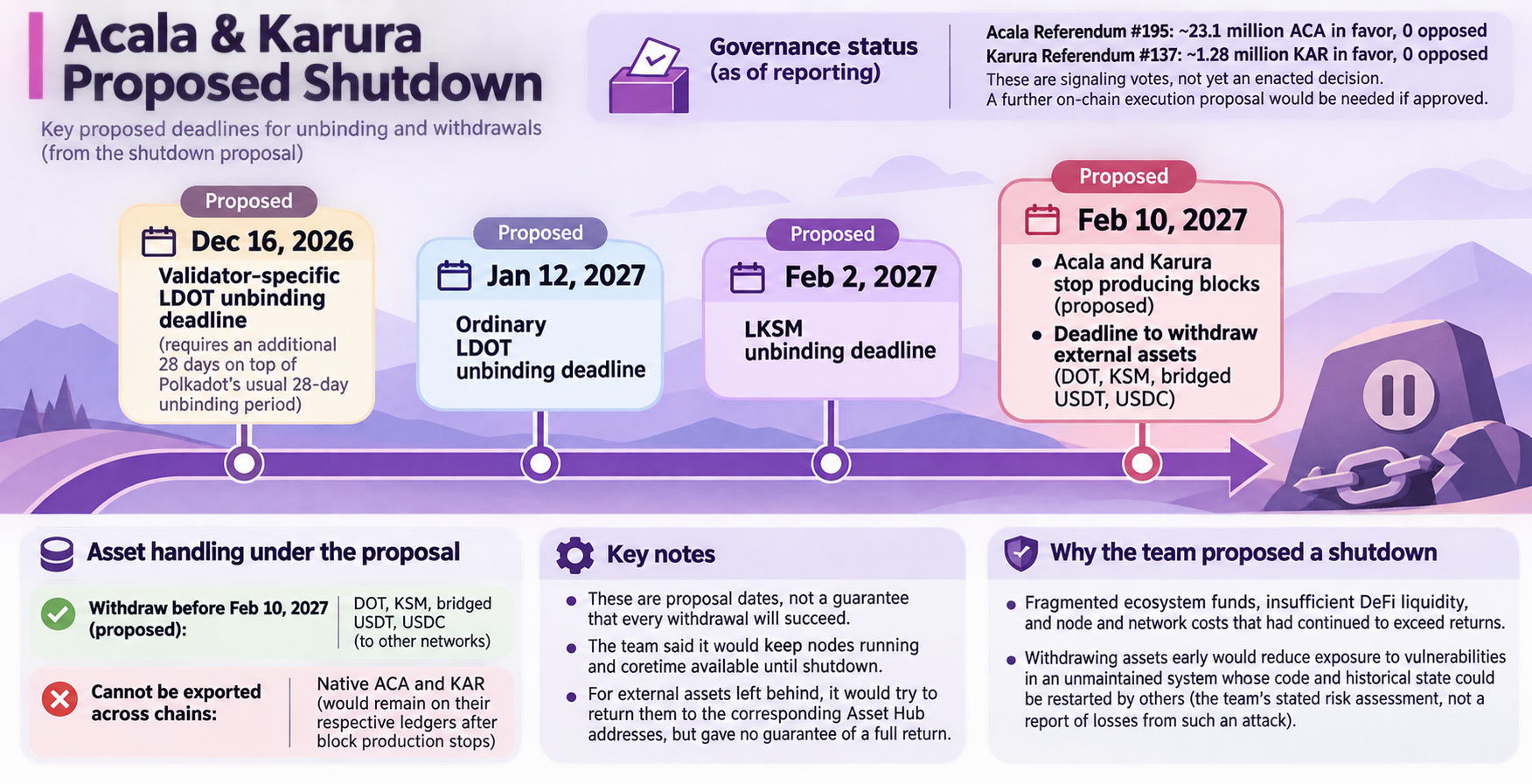
Proposed deadlines for holders
The plan calls for DOT, KSM, and bridged USDT and USDC to be withdrawn to other networks before February 10, 2027. Native ACA and KAR cannot be exported across chains and, under the plan, would remain on their respective ledgers after block production stops.
Liquid-staking positions have earlier unbinding deadlines:
- December 16, 2026: LDOT tied to certain validators, because its release requires an additional 28 days on top of Polkadot’s usual 28-day unbinding period.
- January 12, 2027: ordinary LDOT.
- February 2, 2027: LKSM.
These are dates in the proposal, not a guarantee that every withdrawal will succeed. The team said it would keep nodes running and coretime available until shutdown. For external assets left behind, it would try to return them to the corresponding Asset Hub addresses, but gave no guarantee of a full return.
The team attributed the proposed closure to fragmented ecosystem funds, insufficient DeFi liquidity, and node and network costs that had continued to exceed returns. It also argued that withdrawing assets early would reduce exposure to vulnerabilities in an unmaintained system whose code and historical state could be restarted by others. That is the team’s stated risk assessment, not a report of losses from such an attack.
At the time of reporting, Subsquare data showed approximately 23.1 million ACA voting in favor of Acala Referendum #195 and 1.28 million KAR in favor of Karura Referendum #137, with no opposing votes recorded for either. Holders assessing their next steps should distinguish those preliminary votes from the later execution proposal and check which proposed deadline applies to each asset they hold.