Moving a balance that has sat untouched for years makes the full destination check the part that matters most. One address that received ETH in Ethereum’s 2015 genesis block, then stayed quiet for 11 years, showed how that check played out.
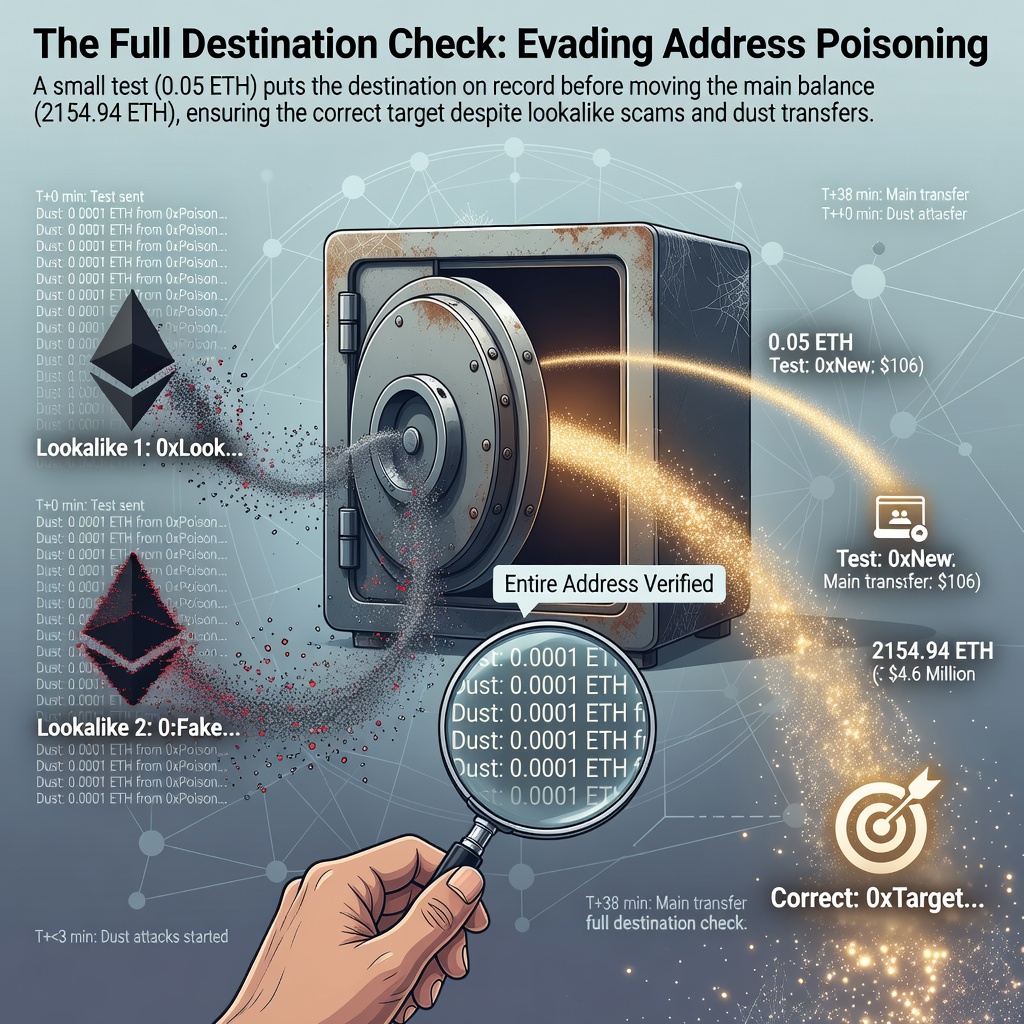
On November 10, 2026, PANews reported, citing CoinDesk, that the address made its first outbound transfers that day. It first sent 0.05 ETH (about $106) as a test to a new address. Thirty-eight minutes later it transferred 2154.94 ETH (about $4.6 million) to the correct target address.
Less than three minutes after the test transaction, two addresses that closely matched the target at the beginning and the end started sending tiny amounts of ETH to the long-dormant wallet. The report described this as a typical address-poisoning attempt: lookalike addresses and dust transfers are placed in transaction history in the hope that a later copy will use the wrong destination.
The owner did not use those lookalikes. The larger transfer went to the correct address.
A small test costs a little ETH and a short wait, but it puts the destination on record before the main balance moves. When unexpected tiny transfers appear, the relevant check is the entire address, not only the characters at each end. One completed transfer does not remove risk from later moves.
Original article (PANews, November 10, 2026): https://www.panewslab.com/zh/articles/01a1c456-e600-71a5-bcf8-27b28933a6a8