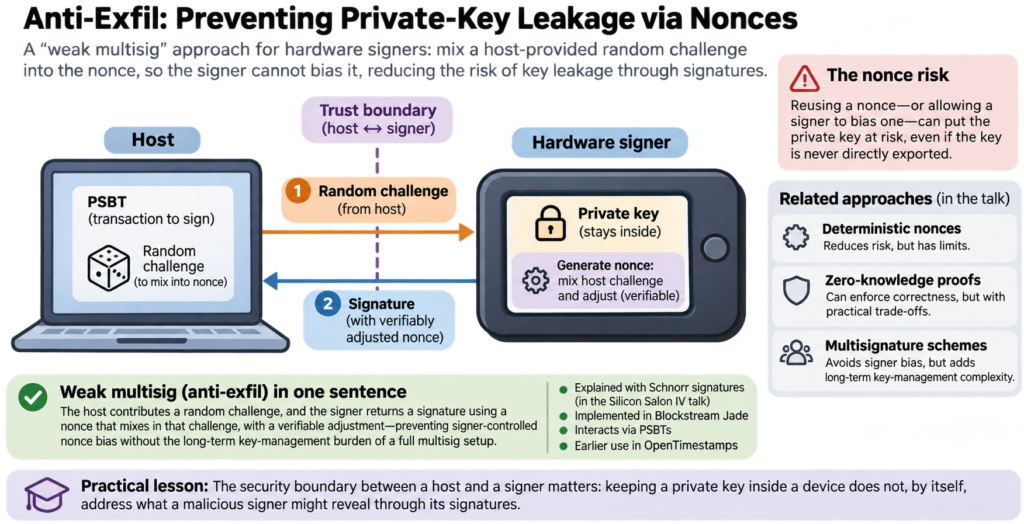
When a hardware signer produces a signature, the nonce is a security boundary worth understanding. Reusing a nonce—or allowing a signer to bias one—can put the private key at risk, even if the key is never directly exported.
In an account published on November 15, 2026, Andrew Poelstra’s Silicon Salon IV talk uses Schnorr signatures to explain this risk and the anti-exfil approach. The talk considers deterministic nonces, zero-knowledge proofs and multisignature schemes, while noting limitations to each.
The approach described is a form of “weak multisig”: the host contributes a random challenge, and the signer produces a nonce whose adjustment can be verified. By mixing the host’s contribution into the nonce, the protocol aims to prevent signer-controlled nonce bias without adding the long-term key-management burden of a full multisignature setup.
The account also covers an implementation in Blockstream Jade, interaction through PSBTs, and earlier use of the approach in OpenTimestamps. Its practical lesson is about the boundary between a host and a signer: keeping a private key inside a device does not, by itself, address what a malicious signer might reveal through its signatures.