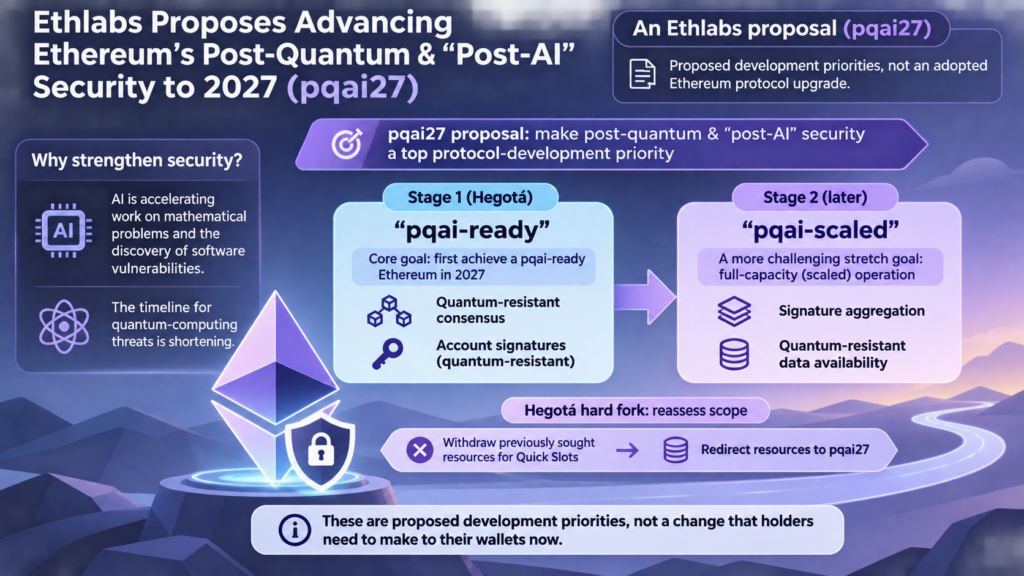
For anyone planning to hold assets on Ethereum long term, the security of the network’s signatures matters. In a report published on November 12, 2026, at 11:12 a.m. UTC+8, Odaily said Ethlabs had proposed moving Ethereum’s post-quantum and “post-AI” security goals forward to 2027. The proposal, called pqai27, is not an adopted protocol upgrade.
Ethlabs argued that AI is accelerating work on mathematical problems and the discovery of software vulnerabilities, while the timeline for quantum-computing threats is shortening. It called for cryptographic approaches with fewer security assumptions, stronger client security and formal verification, and proposed making pqai27 the top protocol-development priority.
To pursue that goal, Ethlabs suggested reassessing the scope of the planned Hegotá hard fork. It said it would withdraw resources it had previously sought for Quick Slots and redirect them to pqai27. Its preliminary roadmap puts quantum-resistant consensus and account signatures in Hegotá, aiming first for a “pqai-ready” Ethereum in 2027. Signature aggregation and a quantum-resistant data-availability approach would come later to support “pqai-scaled” operation at full capacity—a more challenging stretch goal, according to Ethlabs.
These are proposed development priorities, not a change that holders need to make to their wallets now.
Source: odaily.news (originally published 2026-11-12 11:12 UTC+8)