An address traced to Ethereum’s 2015 genesis block encountered an address-poisoning attempt shortly before moving 2,154.94 ETH. In its November 10, 2026 report, Odaily said the larger transfer went to the intended address; it reported no loss from the attempted deception.
According to Whale Alert monitoring cited by Odaily, the old address (0x7dD…) made its first outgoing transfer at 6:04 a.m. Beijing time on November 10: a 0.05 ETH test payment, worth about $106. The address had first received ETH in the genesis block in July 2015 and received another 755 ETH in March 2016. It had not previously sent ETH out.
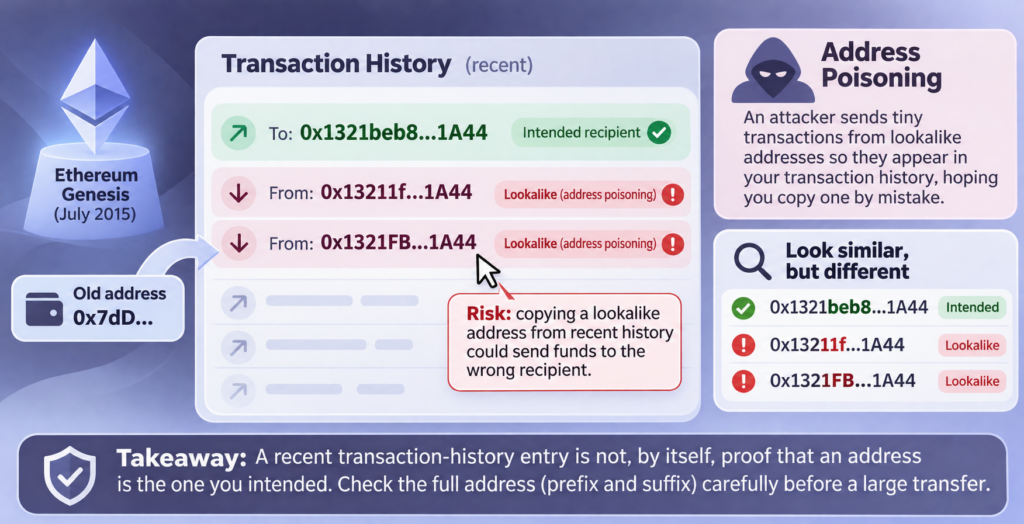
The test payment went to an address beginning 0x1321beb8 and ending 1A44. About three minutes later, the old address began receiving multiple tiny ETH transfers from two lookalike addresses. They began 0x13211f and 0x1321FB, respectively, and both ended 1A44. Odaily said an account funding those addresses was labeled “Fake_Phishing”; the more active lookalike address sent 43 dust transfers.
This is the address-poisoning risk: a lookalike destination appears in transaction history, where someone might copy it instead of the intended address. At 6:20 a.m., the new recipient address sent out 0.01 ETH, almost all of which returned about three minutes later. At 6:42 a.m.—roughly 38 minutes after the first test—the old address sent 2,154.94 ETH, worth about $4.6 million, to the intended address beginning 0x1321beb8 and ending 1A44. Odaily reported that the recipient then held about 2,155 ETH.
For anyone checking a destination before a large transfer, the distinction is practical: a recent transaction-history entry is not, by itself, proof that an address is the one intended. The prefixes and suffixes reported here show how similar entries can look while referring to different addresses.