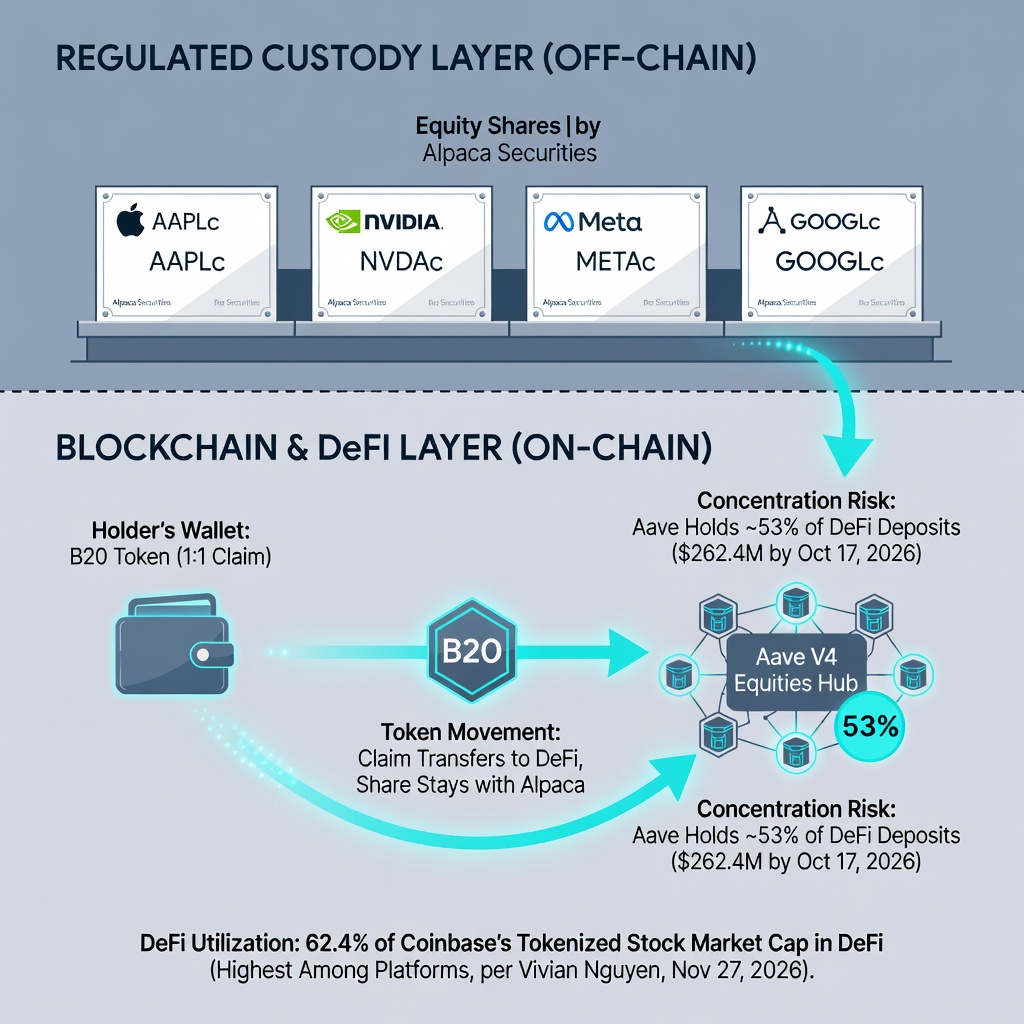
A holder can use a Coinbase stock token as collateral on Base, but the underlying share stays with Alpaca Securities. On November 27, 2026, Vivian Nguyen reported that 62.4% of the market value of Coinbase’s tokenized stocks was in decentralized finance (DeFi) markets. That was the highest proportion among tokenized-equity platforms. It measures how much of Coinbase’s own offering was in DeFi, not Coinbase’s share of the overall market.
What the holder controls
Coinbase launched its stock tokens on August 24, 2026, using the B20 token standard on Base, its layer-2 network. The initial offering provided fractional exposure to Apple (AAPLc), Nvidia (NVDAc), Meta (METAc) and Alphabet (GOOGLc). Each token represents a 1:1 claim on a share that Alpaca Securities holds in regulated custody. Moving the token between a wallet and a DeFi application moves the claim; it does not change who holds the share.
Coinbase offers the tokens under Regulation S to eligible non-US users, not to US users. Eligible holders can trade around the clock or deposit tokens in a lending market to back a loan or earn yield from borrowers.
Where deposits are concentrated
Across Base, DeFi deposits tied to tokenized stocks rose from about $14.7 million at the start of 2026 to $262.4 million by October 17, roughly an eighteenfold increase. Aave V4’s Equities Hub held about 53% of those deposits in a mid-October snapshot. That concentration is a separate dependency from share custody: a problem at the lending venue could affect a large share of deposited assets even if the underlying shares remain with Alpaca.
By late October, cumulative trading volume for Coinbase’s stock tokens on decentralized exchanges had passed $4 billion. That figure counts trades over time. By contrast, the estimated $3 billion to $3.75 billion in total on-chain value for the entire tokenized-equities sector measured the value of outstanding tokens in late October, not trading activity.