Bitcoin holders were locking in losses at the fastest pace since the November 2022 collapse of FTX, relative to the capital that had entered the network over the preceding year. Glassnode’s November 25, 2026, analysis called this the first major bout of capitulation in the current bear market. It stopped short of calling a bottom: much of the leveraged buying had been cleared out, but there was little sign that U.S. spot buyers were stepping in.
The analysis used data through 16:00 UTC on November 24, or midnight on November 25 in Beijing.
Bitcoin gave back its rally before the Nasdaq did
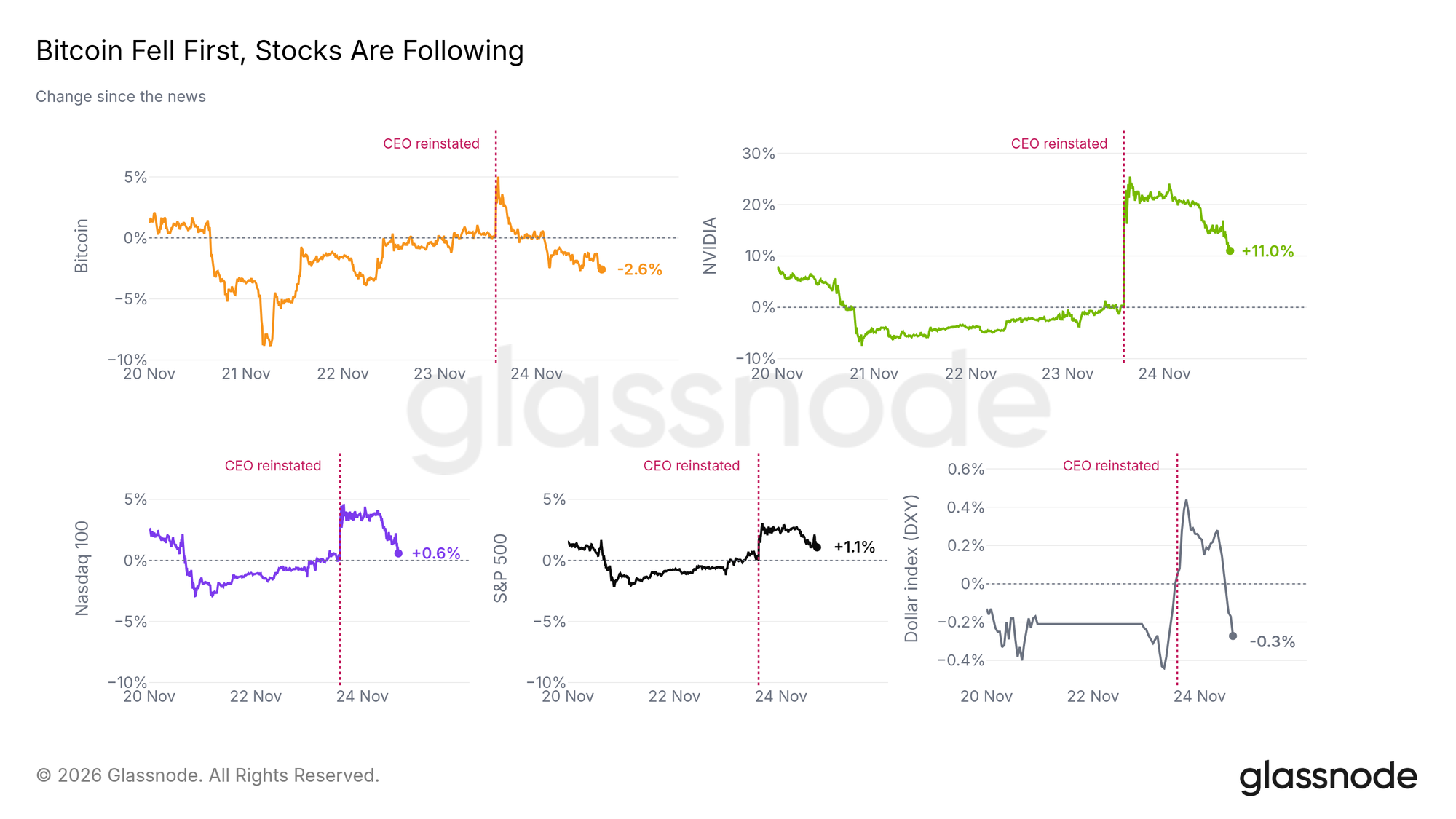
According to Glassnode, Nvidia’s November 23 reappointment of Jensen Huang as CEO, less than two weeks after his resignation, coincided with a rally in U.S. stocks and a 5% rise in bitcoin in half an hour. Within six hours, bitcoin had given back the entire gain. The Nasdaq 100 was still holding about three-quarters of its advance at that point, though it surrendered most of the gain on November 24.
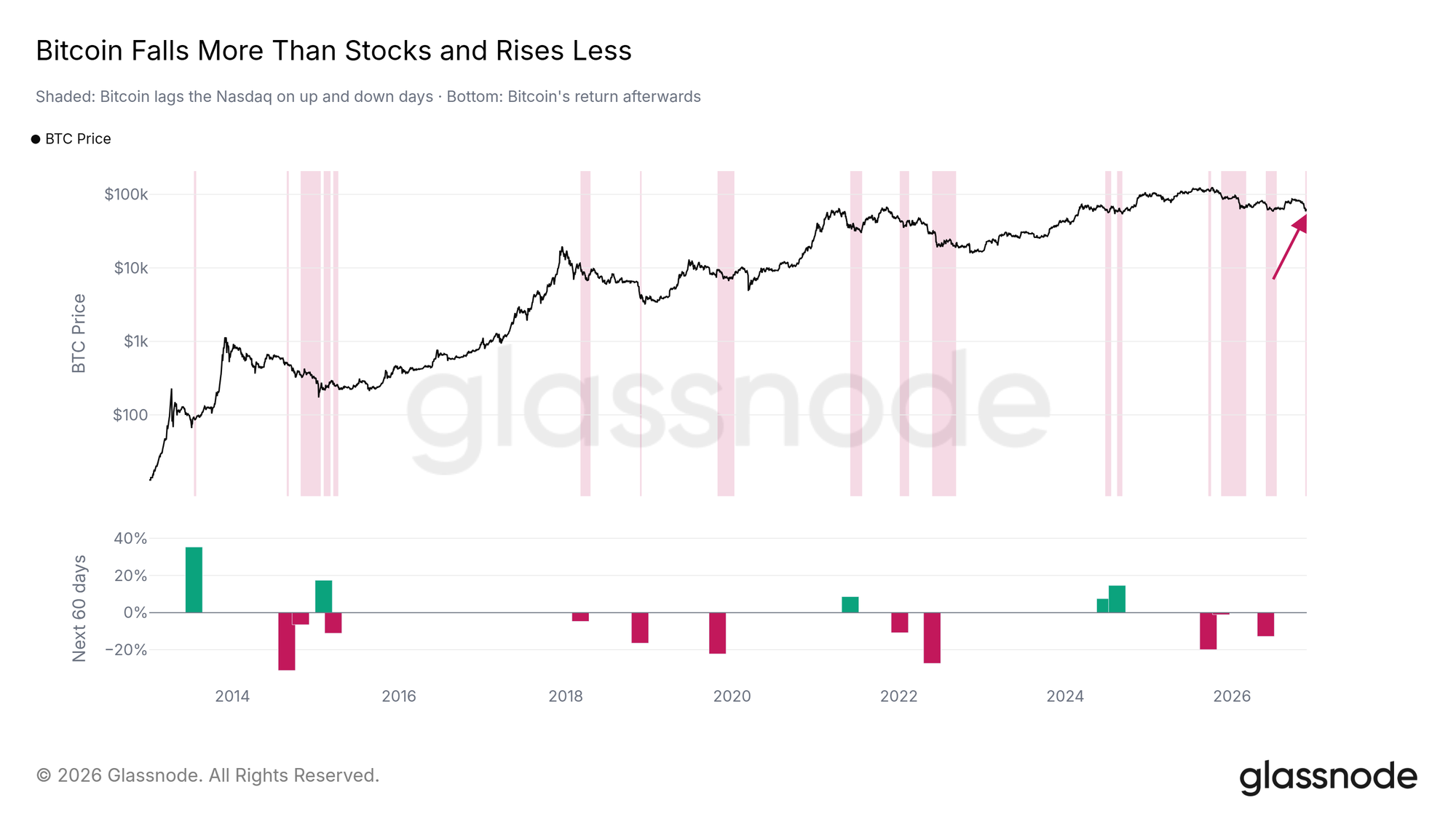
The divergence extended beyond that session. Over the preceding 60 trading days, bitcoin had gained less than the Nasdaq 100 on the index’s up days and fallen more on its down days. In about two-thirds of comparable periods since 2013, bitcoin was lower 60 days after the pattern began. Glassnode identified exceptions in 2013, 2015, 2021 and 2024.
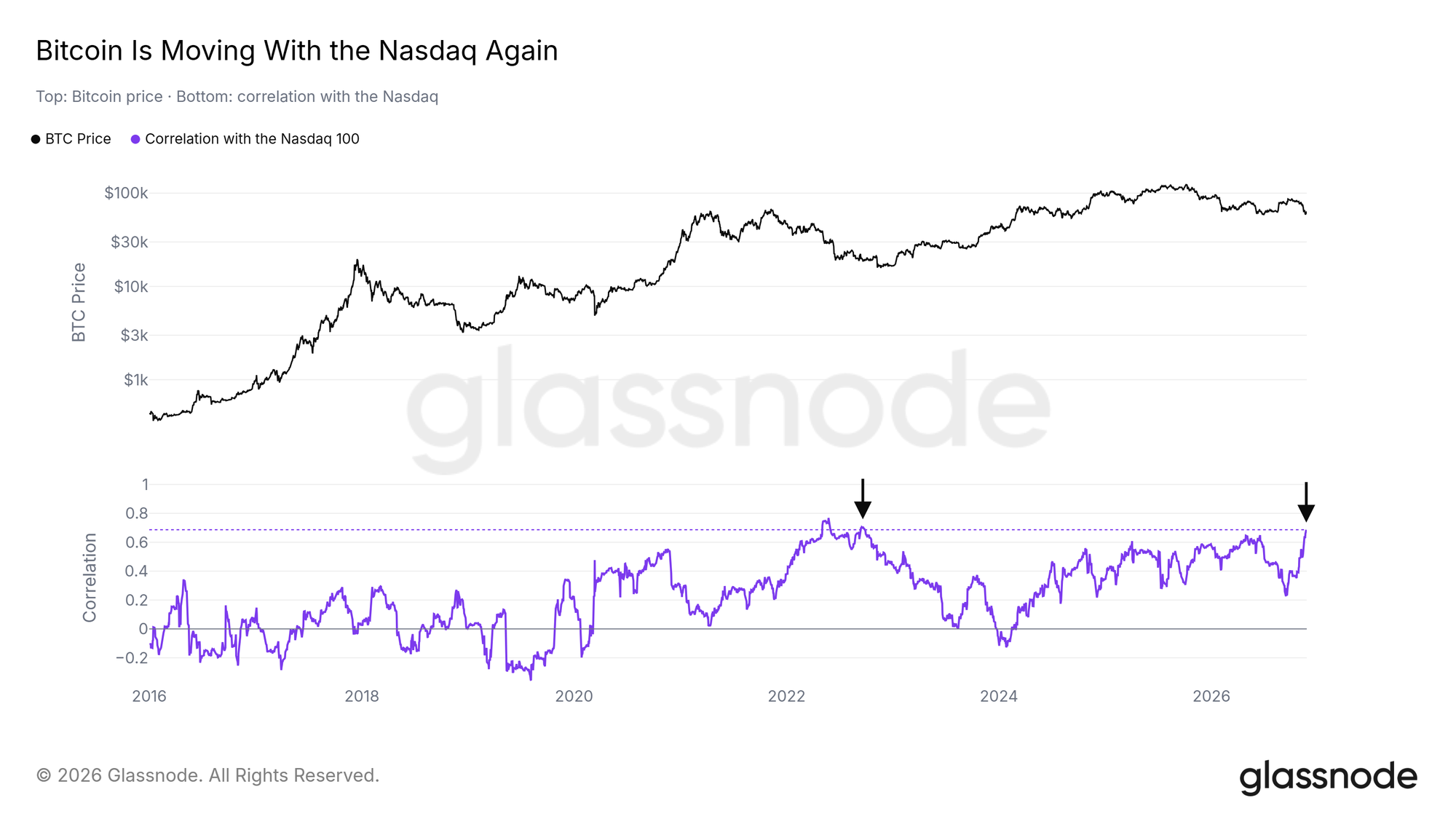
At the same time, bitcoin’s correlation with the Nasdaq 100 had risen to its highest level since September 2022. The two markets were moving more closely together, but that did not mean their returns were equal: bitcoin was taking the larger losses. Glassnode judged that a sustained bitcoin recovery would be difficult without some stabilization in equities if the correlation stayed high.
An intraday break below the summer lows, but not a closing break
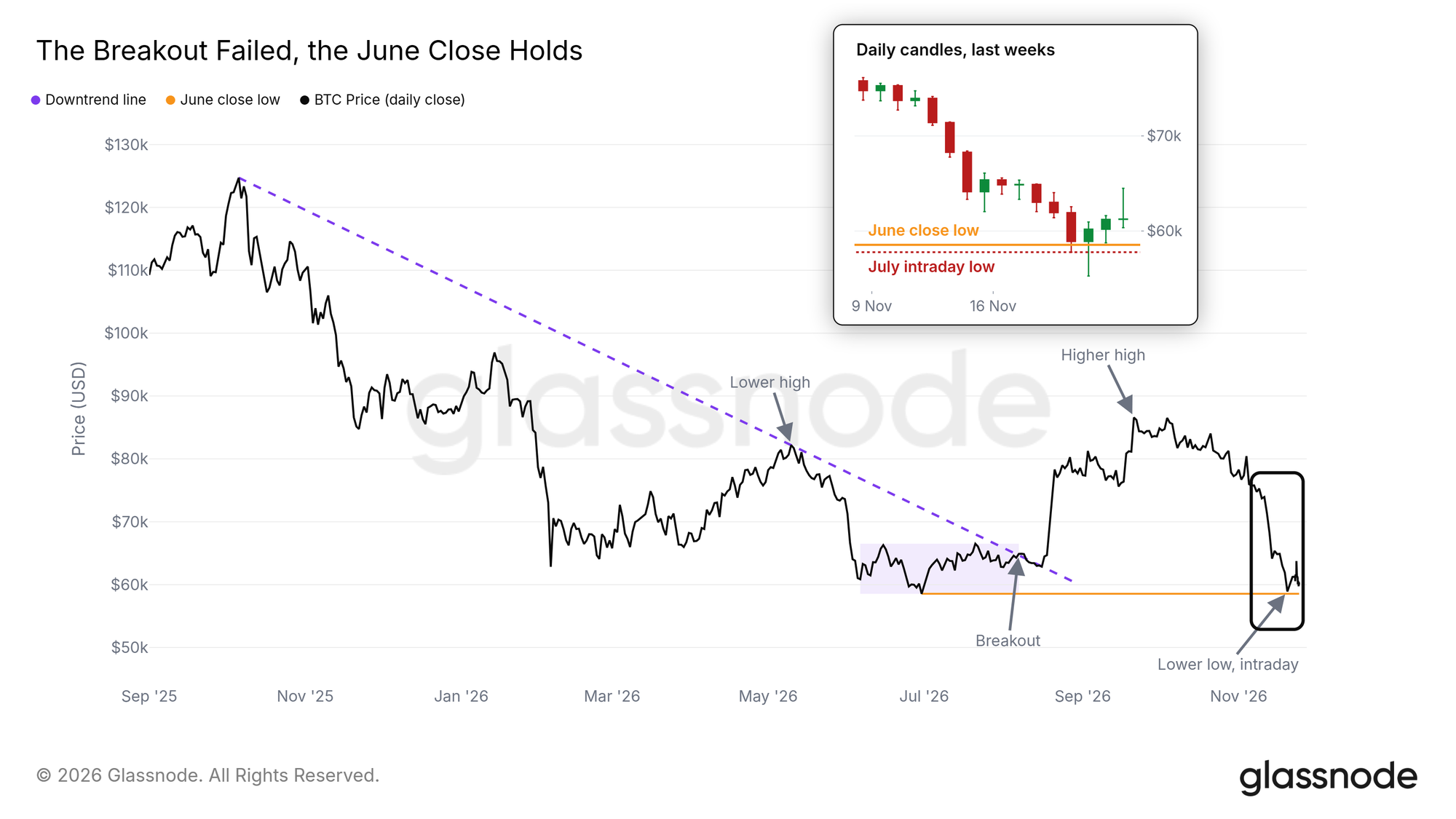
Bitcoin closed below the $62,000–$66,000 range on November 19. That was where many recent buyers had acquired their coins, and Glassnode now viewed it as an area of resistance. The August breakout had failed to hold despite a subsequent September high near $87,000.
On November 21, bitcoin traded as low as $55,300, below the intraday lows of both June and July. Daily closes told a different story. The sell-off’s lowest close, on November 20, remained just above June’s closing low of $58,500. Glassnode therefore treated the decline as a second test of summer support, although it noted that bitcoin was struggling around $60,000 rather than rebounding decisively.
Most of the nearby leveraged longs had cleared
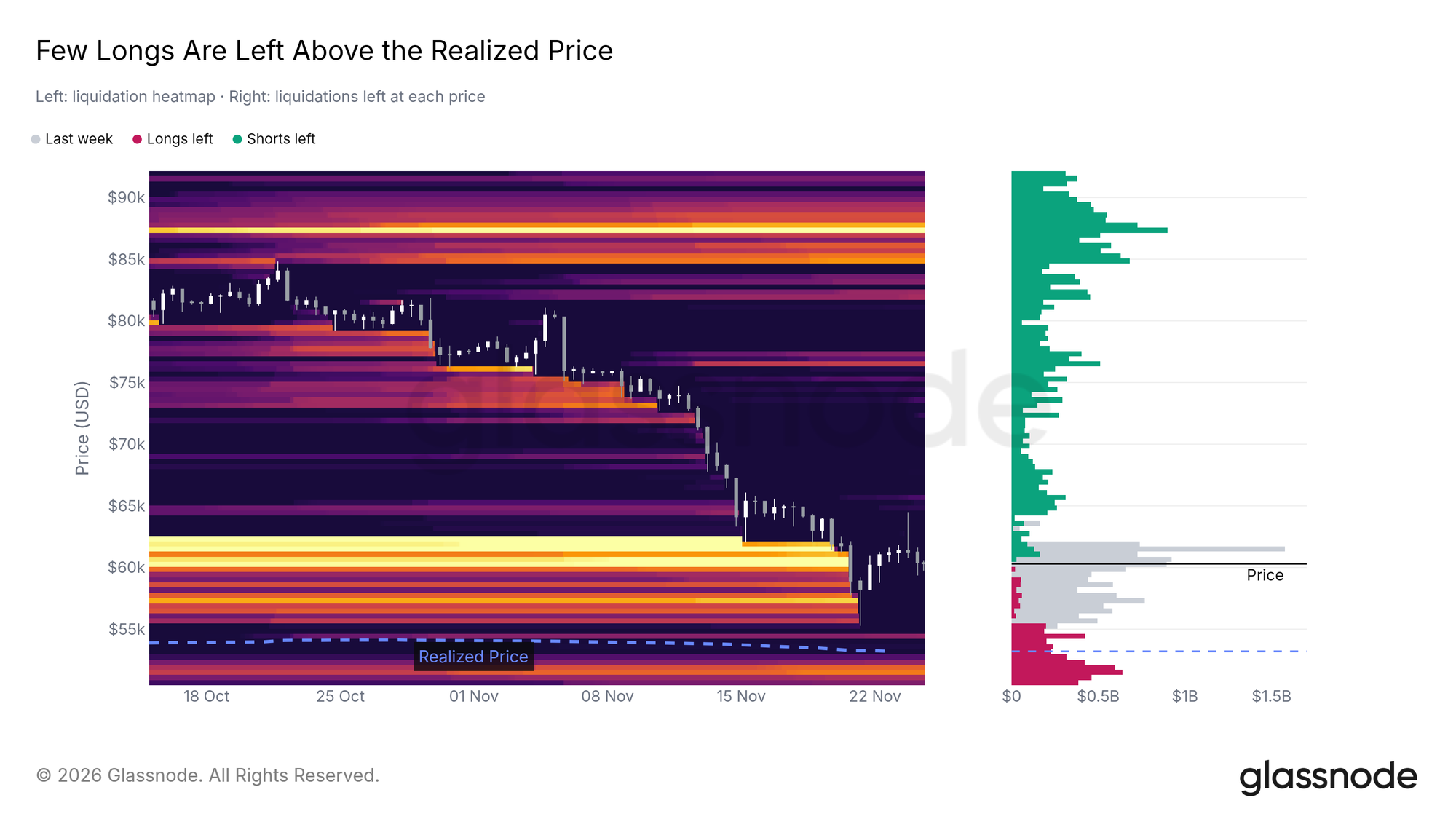
A week earlier, Glassnode’s liquidation heatmap had shown a concentration of leveraged long positions between $55,000 and $62,000. The heatmap models where futures positions may be forcibly closed; it is not a ledger of individual liquidations. Glassnode estimated that nearly 90% of the longs that had stood between the prevailing price and the network’s realized price a week earlier had been cleared. That left less potential for forced selling above realized price, not necessarily more demand.
Most of the remaining modeled liquidations were shorts above the market, with the largest cluster near $87,500. A smaller group of longs remained near $51,500, below realized price.
U.S. ETF outflows coincided with net selling on Coinbase
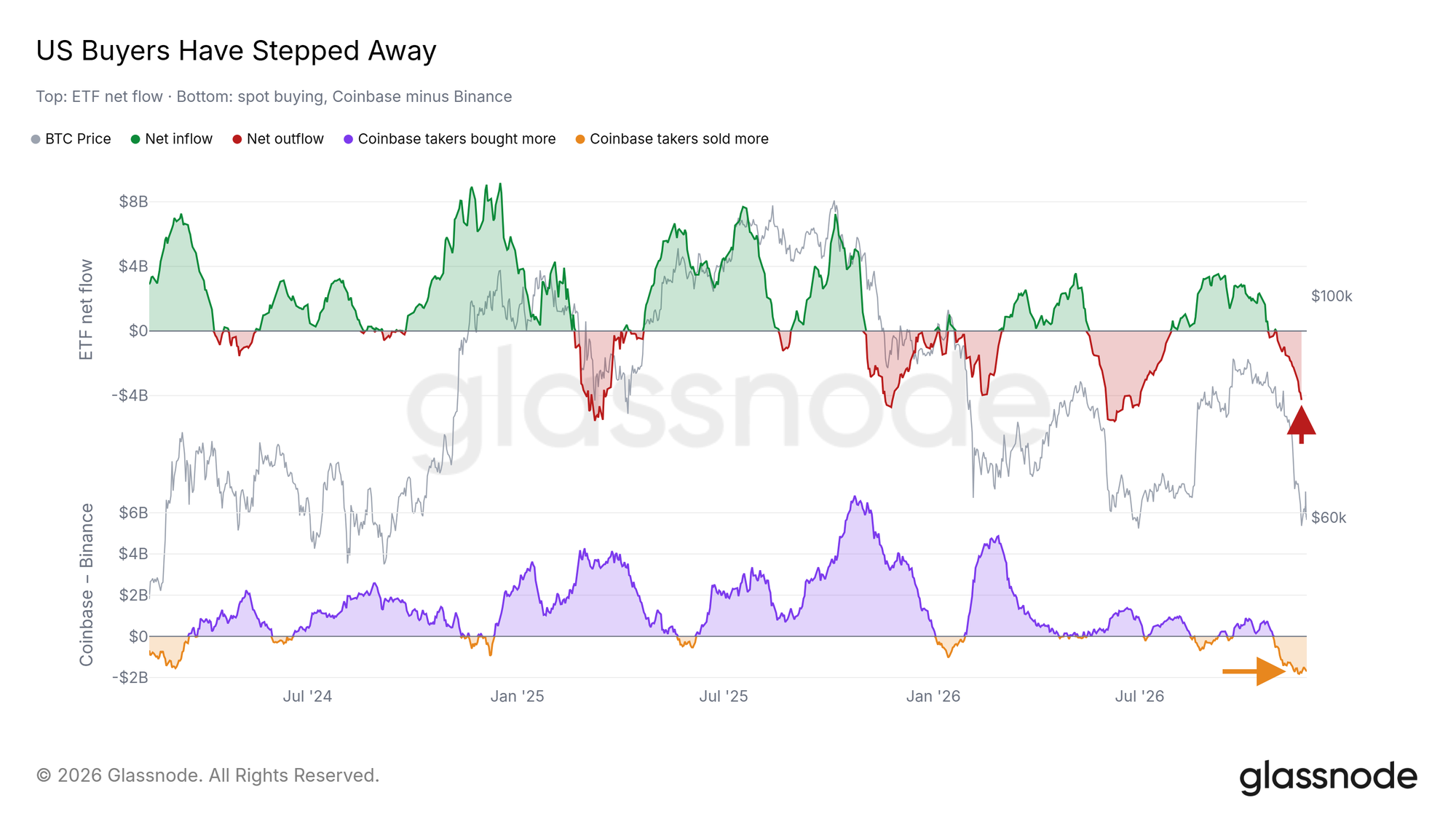
U.S. spot bitcoin exchange-traded funds recorded $4.3 billion in net outflows over 20 trading days, one of their largest withdrawals over such a period since launch. Over 30 days, traders taking available prices on Coinbase were heavy net sellers, while buying and selling on Binance were roughly balanced.
Glassnode saw the loss of U.S. demand as one reason bitcoin had underperformed equities. It said sustained ETF inflows accompanied by net buying on Coinbase would offer stronger evidence of a return by buyers than a short-lived price bounce alone.
Dealer hedging could amplify moves between $58,000 and $64,000
Glassnode found options dealers were short gamma between $58,000 and $64,000. In that range, dealers adjusting their hedges would generally need to sell as bitcoin fell and buy as it rose. Those trades could reinforce a move in either direction rather than cushion a decline.
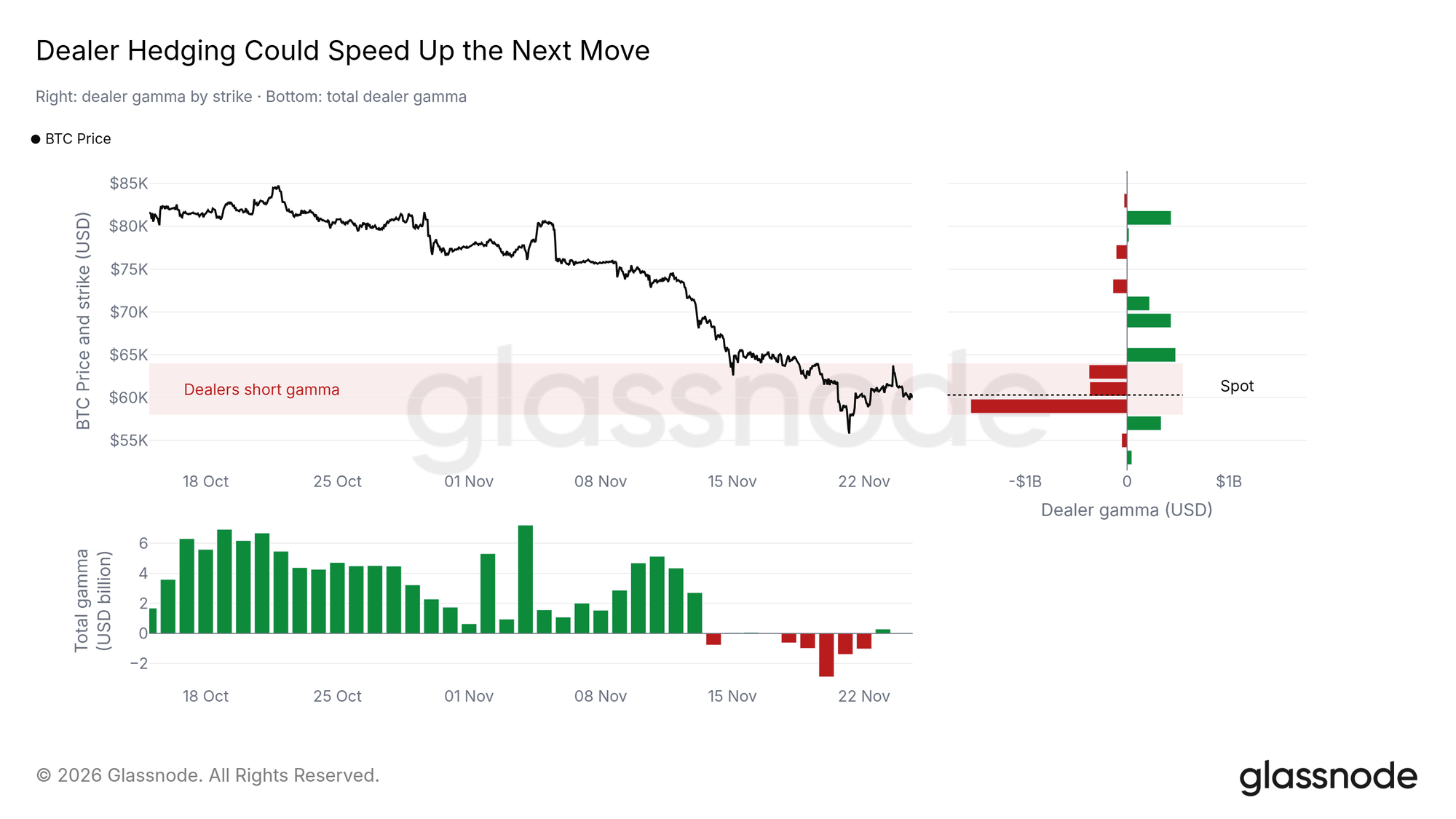
The positioning reversed in the adjacent $56,000–$58,000 and $64,000–$66,000 ranges. There, dealers were long gamma, meaning their hedge adjustments could help slow a price move.
Put trading reached its highest ratio to calls since June 2022
The seven-day average ratio of put volume to call volume reached 1.7 to 1 in the week before the report. It was the highest volume ratio since June 2022. Measured by open interest—contracts still outstanding rather than contracts traded—the put-to-call ratio was the highest since May 2021.
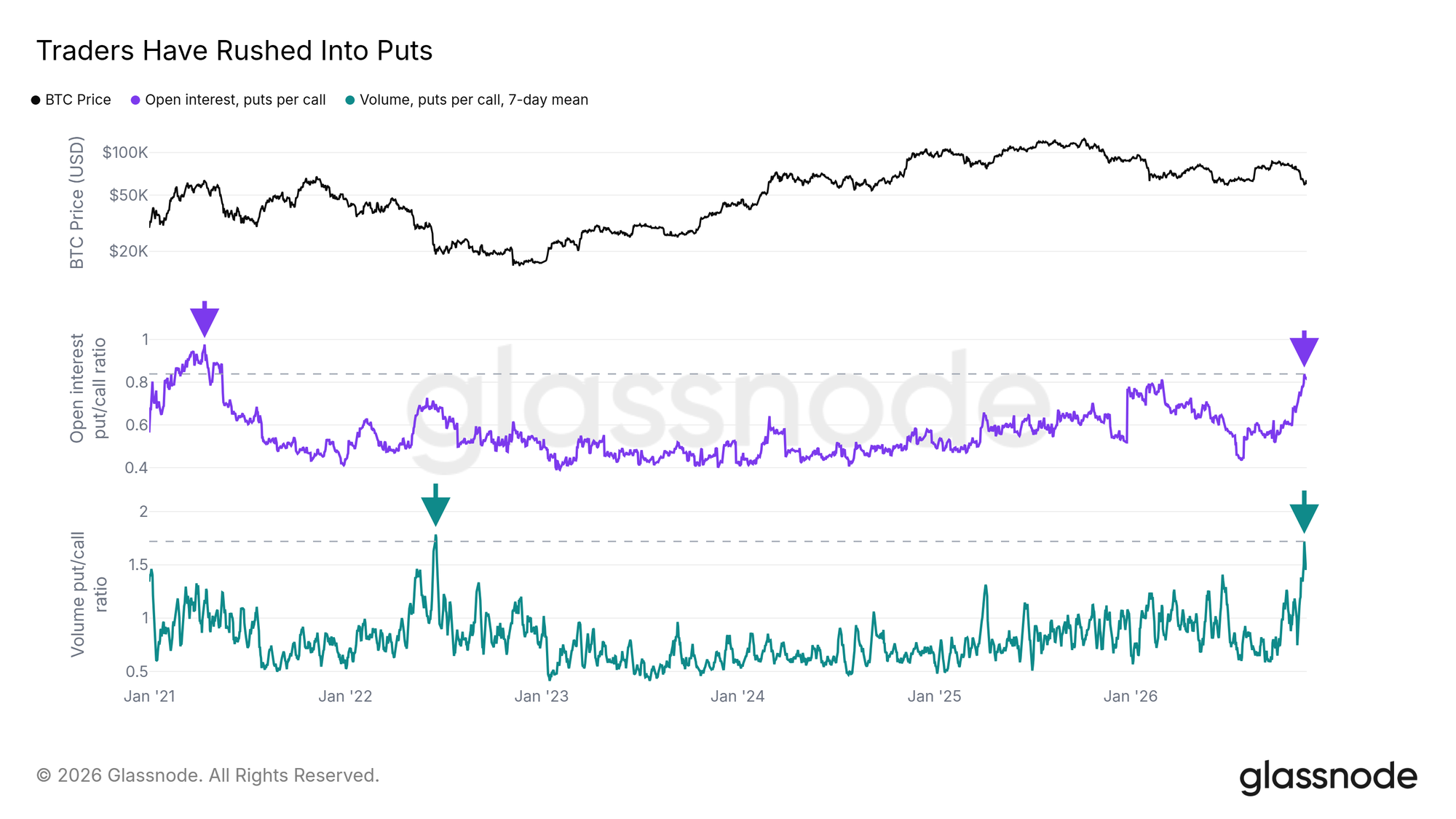
Neither measure reliably marked a bottom. A comparable volume reading in June 2022 coincided with a local low, but the bear market’s ultimate low came five months later. A peak in the open-interest ratio in April 2021 occurred near a market high instead.
Newer buyers joined long-term holders in realizing losses
From mid-April to mid-November, holders of coins aged about five months or more accounted for most of the network’s realized losses. As newer buyers also began taking heavy losses in the sell-off, the long-term holders’ share fell to about half.
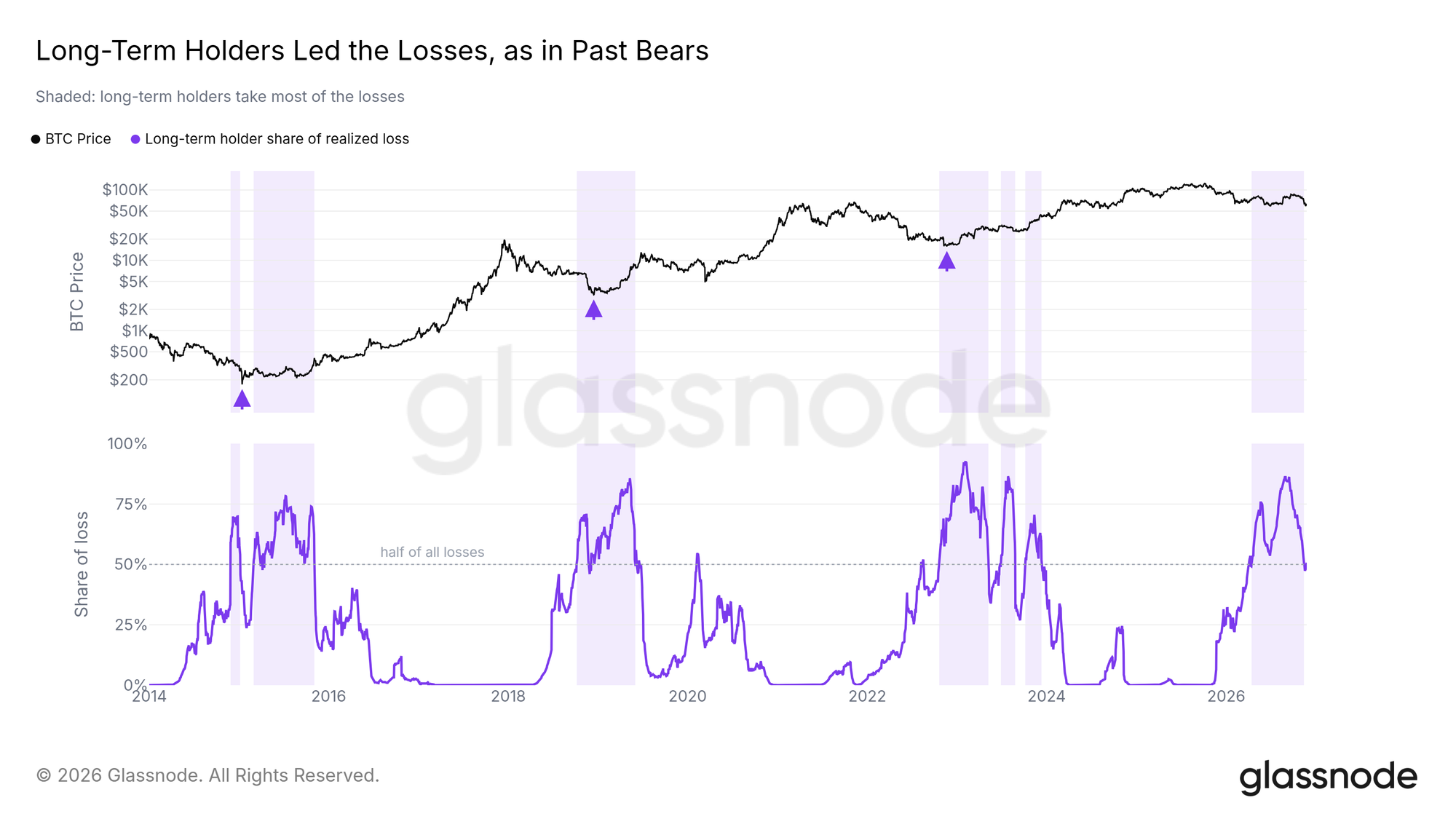
Glassnode found similar periods of loss-taking by long-term holders around the 2015, 2018 and 2022 bear-market lows. It considered the pattern consistent with the later stages of a bear market, but noted that such selling had sometimes continued for months.
Realized price was $53,200, not a guaranteed floor
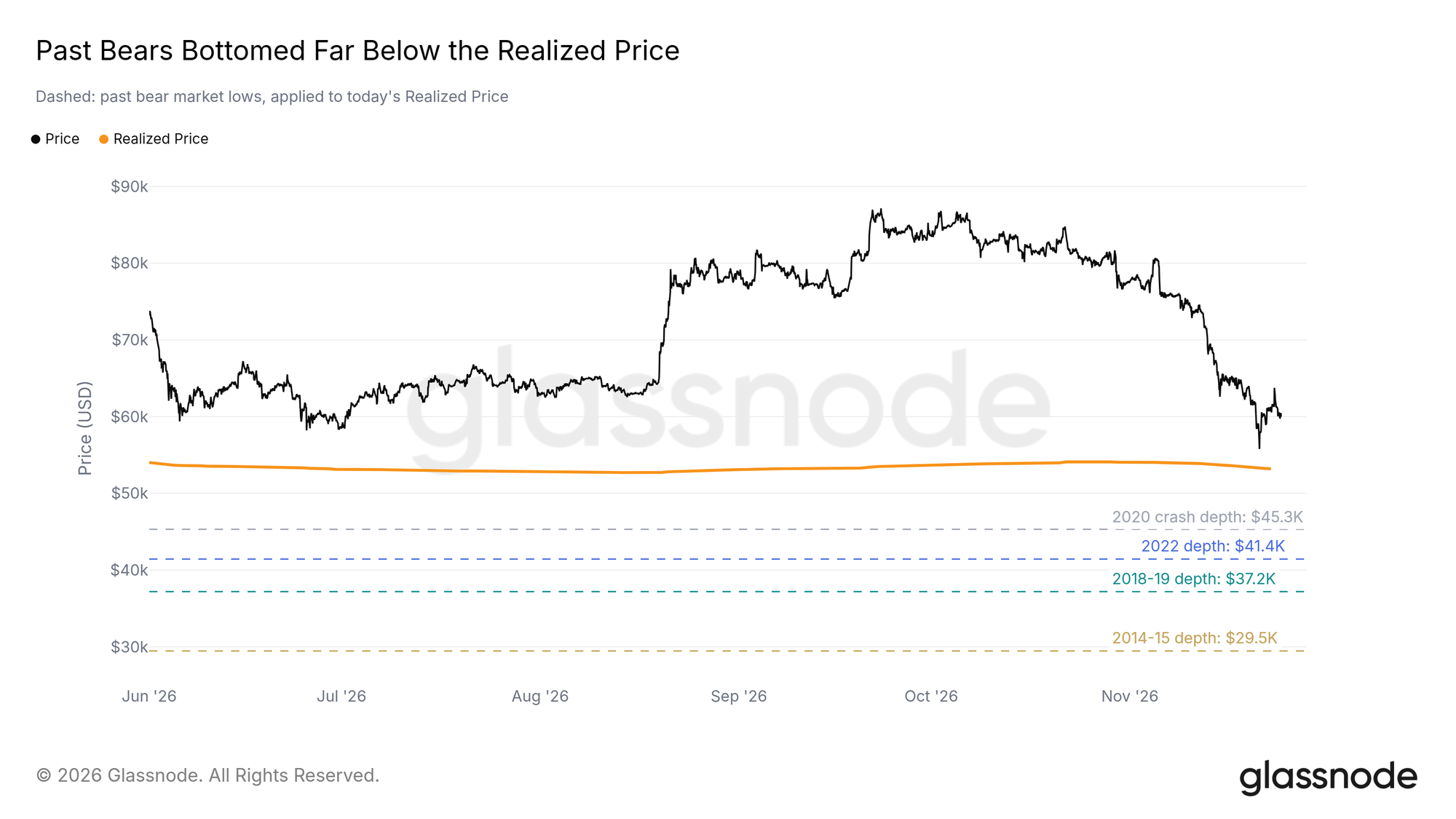
Realized price is the average value of circulating bitcoin based on the price at which each coin last moved on-chain. Bitcoin had fallen roughly halfway from its all-time high but had not closed below its $53,200 realized price in this downturn. At comparable stages in the three preceding bear markets, bitcoin had already fallen at least 75% and reached its eventual low, according to Glassnode.
Past bear-market bottoms had fallen below realized price. Applying the depth of earlier breaks to the November 2026 benchmark gave equivalents of about $41,000 for the 2022 low, $37,000 for the 2018 low and $45,000 for the brief March 2020 liquidity crash. Those figures are historical comparisons, not price targets.
The loss spike signaled capitulation, not its end
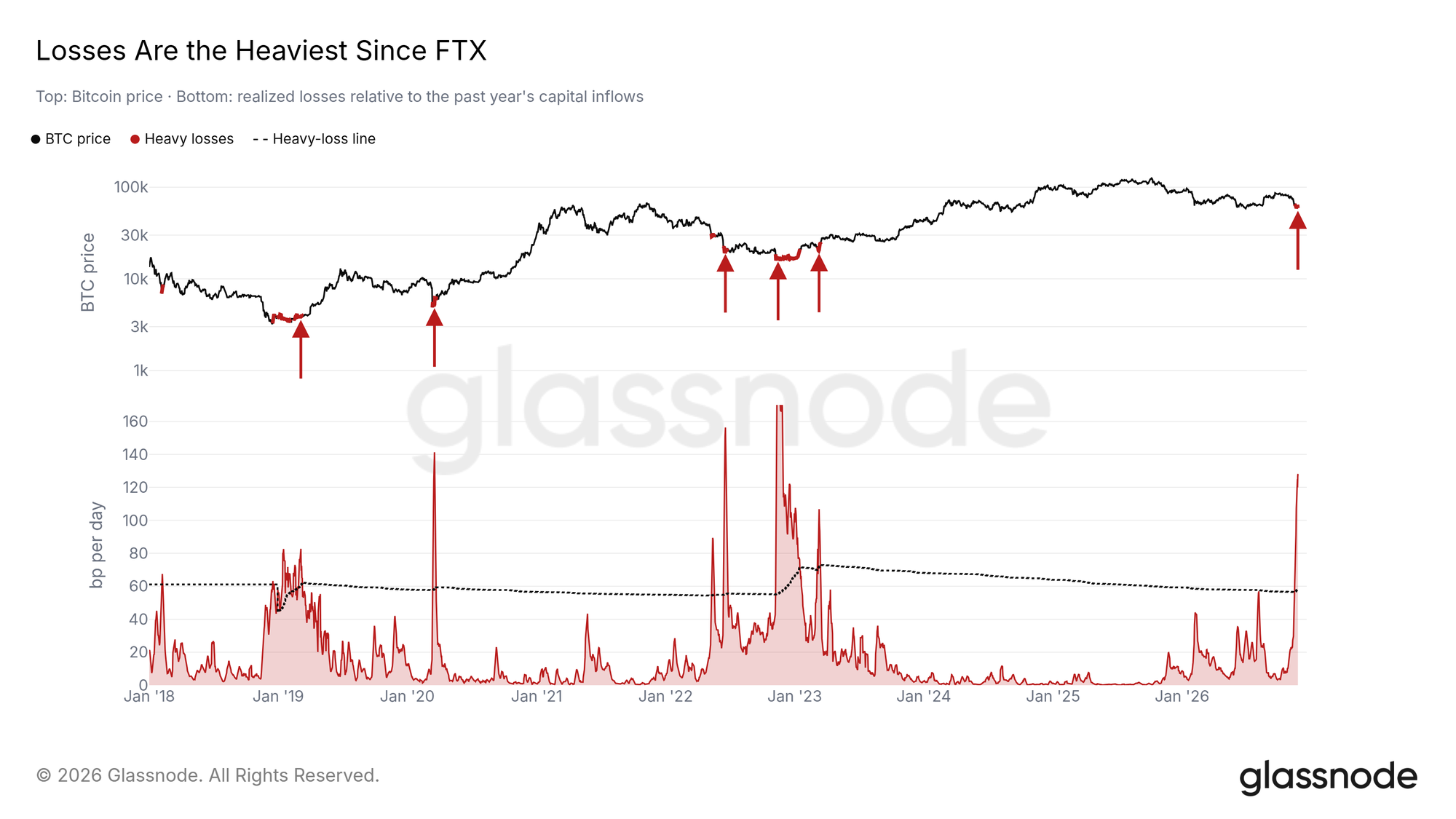
Realized loss measures the loss recorded when coins move on-chain below their prior cost basis. To compare different years, Glassnode scaled those losses against the capital that had entered the network over the preceding year. On that basis, network-wide realized losses nearly doubled from the previous week and reached their highest level since November 2022.
Loss spikes occurred near lows in early 2019, March 2020 and November 2022. Others, including those in February 2018 and May and June 2022, preceded further declines. For Glassnode, the immediate distinction was whether bitcoin could hold its summer closing low. A decisive loss of $60,000 followed by a close below $58,500 would, in its assessment, make a move toward $53,200 more likely. Sustained ETF inflows and a firm recovery away from $60,000 would instead strengthen the case that the summer lows had held.