
If you hold ether, run a validator, or rely on a multisig, the useful question is not how alarming a cryptography headline sounds. It is whether the proof of who may move funds could later change, and which part of your setup that change would actually touch.
The Ethereum Foundation has spent years working to secure the network against a future in which quantum computing breaks the cryptography underneath Ethereum. It is now also treating artificial intelligence as a nearer concern. AI is identifying bugs in live software faster than human reviewers can keep up with, and the Foundation has doubled the size of its protocol security team, according to a recent announcement.
In a post from Devcon, Kev Wedderburn wrote that AI models are identifying thousands of bugs in the Linux kernel, one of the most scrutinized codebases in the world. For Ethereum developers, the immediate challenge is keeping bugs out of software before an upgrade. The longer-term challenge is mathematical.
What the signatures protect
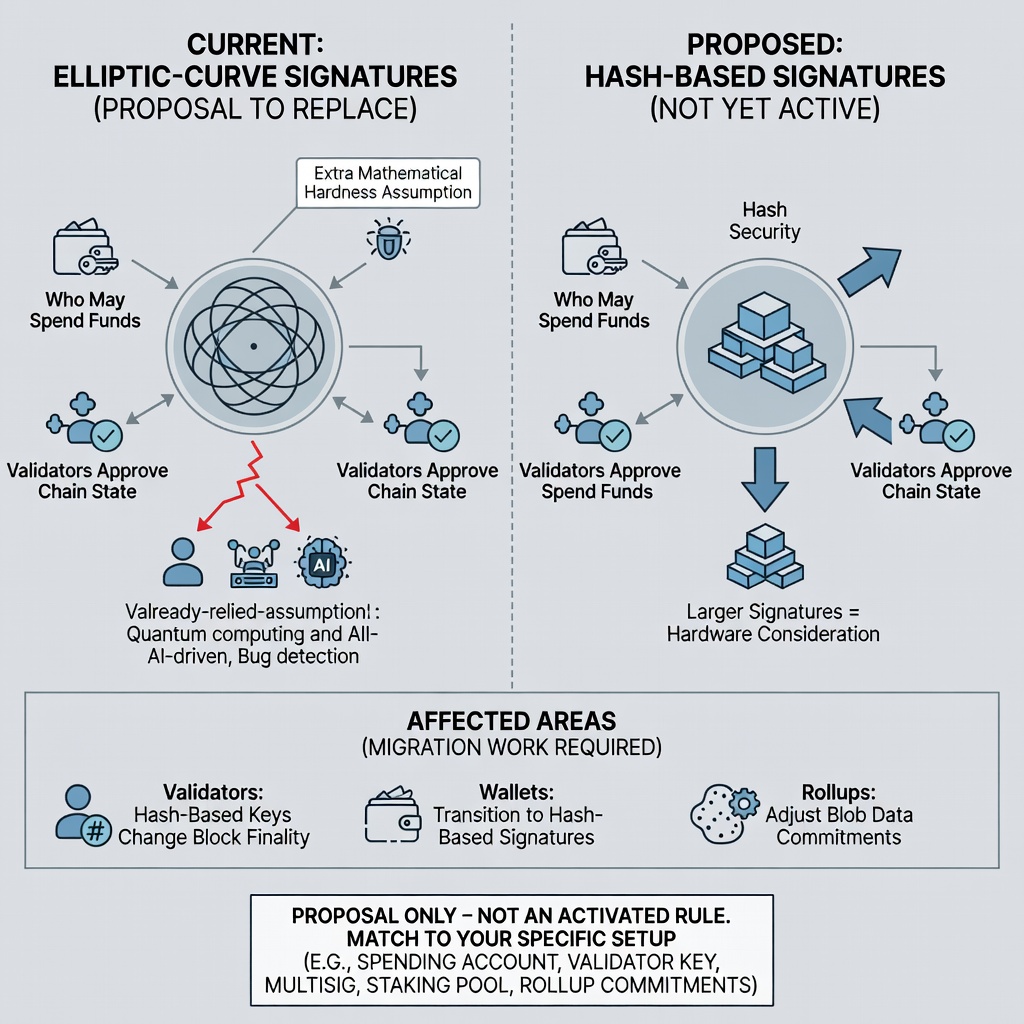
Ethereum uses digital signatures to identify who can spend funds and which validators have approved the state of the chain. Wedderburn says that AI’s advances in analyzing decades-old algorithms raise questions about the mathematical assumptions underlying those signatures, and that researchers should consider those questions.
It is not clear whether AI could break Ethereum’s existing cryptography. The Foundation still wants work on new cryptography to be underway.
A chosen direction, not a live switch
After more than a year of considering various signature schemes, the Ethereum Foundation has decided to replace elliptic-curve signatures with hash-based cryptography. The argument is that Ethereum already relies on cryptographic hash security. Using hashes for signatures as well would remove an additional assumption: that the mathematical problems associated with elliptic curves remain hard to solve.
That choice is still a proposal for how Ethereum would change. It is not described as an activated rule. It would affect three areas:
- Validators would use hash-based keys for their signatures, which would change how block finality is determined on the network.
- Wallet developers would need to give users a way to transition their accounts to hash-based signatures.
- The cryptography used for commitments to blob data that rollups publish to the network would change, so rollups would need to adjust too.
The trade-off for people who hold or operate
The difficulty called out is size. Hash-based signatures are much larger, so developers need to consider how that affects the hardware required to run a node at home. Staking pools and multisig wallets would need adjustments. So would smart contracts that rely on existing cryptography, and tools that rely on BLS, the signature scheme Ethereum validators use now.
Dropping the extra elliptic-curve assumption does not mean a wallet, a validator, or a multisig becomes risk-free. The design would still depend on hash security, which Ethereum already relies on. What changes is the migration work, the size of signatures, and who has to adapt: account holders only if their wallet offers a transition; home-node operators because larger signatures are a hardware question; and pools, multisigs, smart contracts, rollup blob commitments, and BLS-based tools because each of those depends on today’s scheme in a different way.
Nothing in the announcement says existing accounts have already stopped working. A practical check is to separate those pieces instead of treating the proposal as one urgent action. A spending account, a validator key, a multisig, a staking-pool position, and a rollup’s blob commitments are not the same follow-up. Until the wallet or operator software you already use provides a transition, matching the proposal to the specific thing you hold is the step the announcement actually supports.