For readers tracking where tokenized fund shares are available, Stellar’s reported growth is best understood alongside the fund and distribution arrangements behind it. The figures do not, on their own, describe a change in wallet custody.
On November 23, 2026, RWA Foundation shared Token Terminal figures showing $207.2 million in tokenized fund growth on Stellar from November 15 to November 22. Franklin Templeton accounted for $108.0 million of the reported increase and Spiko for $68.2 million. Stellar ranked among the blockchains with the most growth that week; Injective led, according to RWA Foundation.
The weekly figures followed a larger rise in tokenized real-world assets on Stellar. Their value reached $4.1 billion at the end of the third quarter of 2026, up 36% from the previous quarter and 548% from a year earlier. Tradable’s new tokenized private credit and inflows into the Spiko Amundi overnight swap fund drove much of that quarter’s growth.
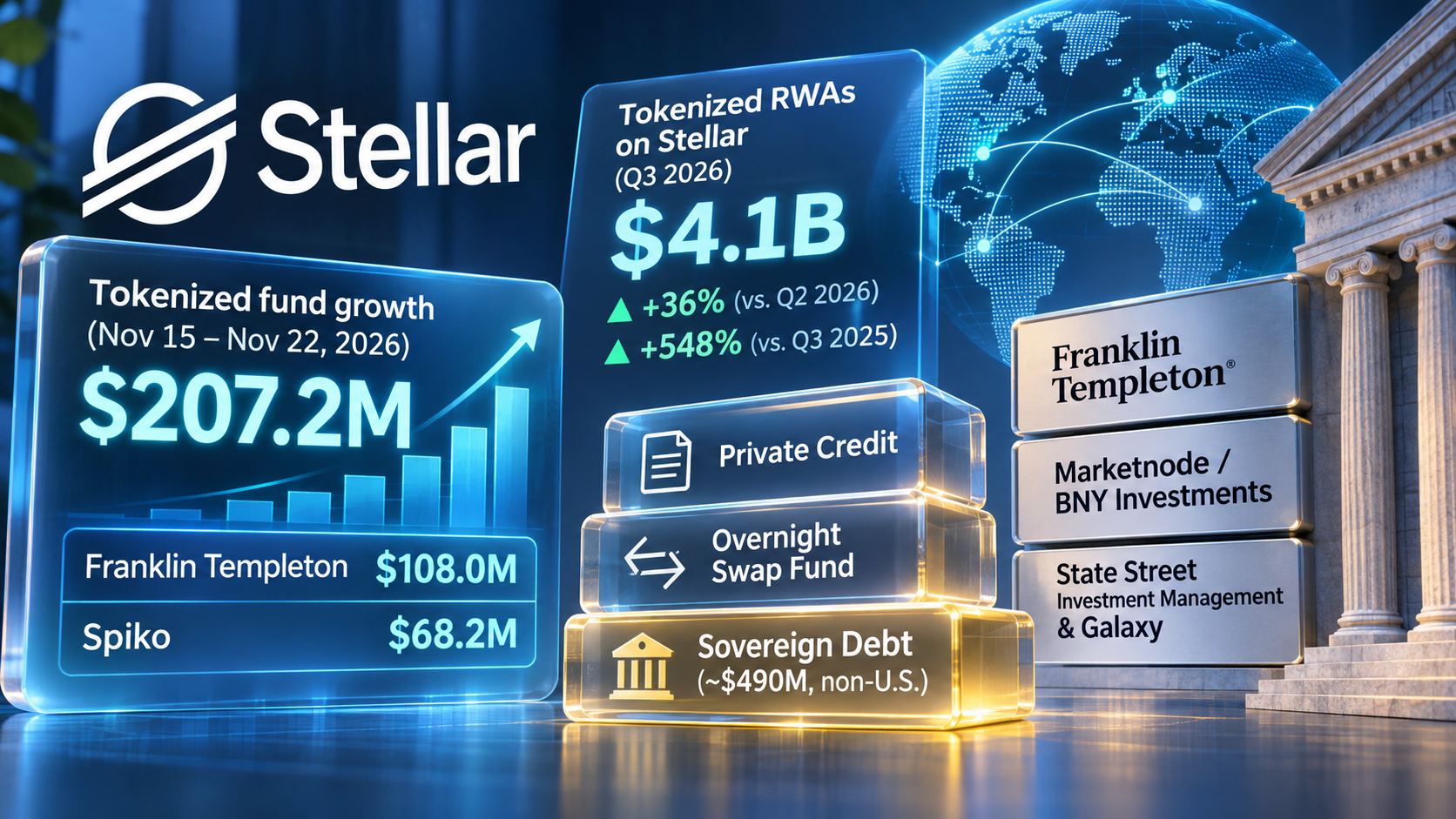
Several developments had widened institutional access to funds on Stellar. Franklin Templeton’s BENJI had been on the network since 2021. In August 2026, the U.S. SEC’s Division of Investment Management issued a no-action letter concerning the use of BENJI for cash management by Franklin Templeton’s registered mutual funds and ETFs. Franklin Templeton also registered grBenji as a Luxembourg UCITS share class for third-party distribution, live on 21X. In Asia, Marketnode announced in August that it would offer BNY Investments funds on Stellar as the tokenization and distribution platform. State Street Investment Management and Galaxy brought their Onchain Liquidity Sweep Fund to Stellar in September.
The network’s tokenized assets also included sovereign debt. In late August 2026, Stellar held about $490 million in tokenized non-U.S. government debt, more than any other blockchain at the time, including instruments from Europe, Mexico, Brazil, South Korea and the Marshall Islands.