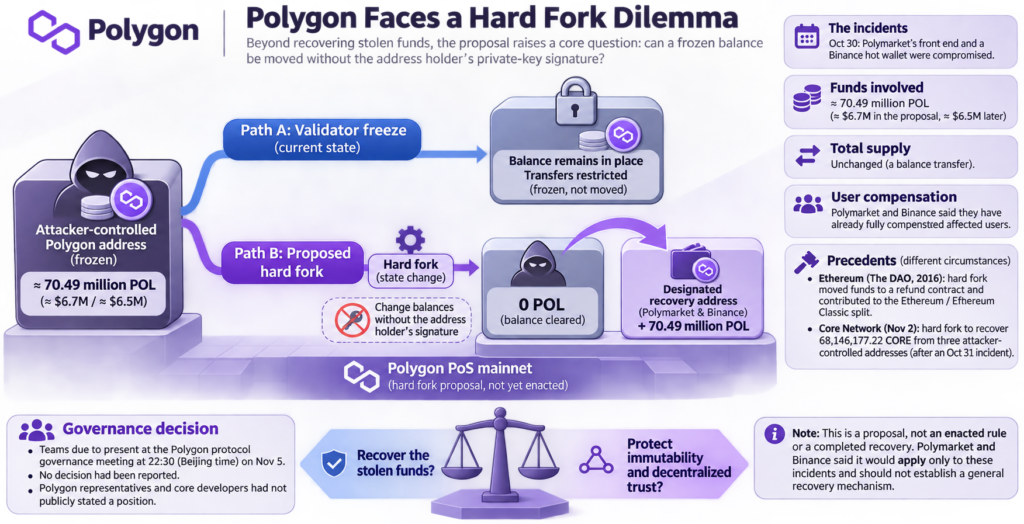
For anyone holding assets on Polygon, the question raised by a proposed hard fork is about more than recovering stolen funds: can a frozen balance be moved without the address holder’s private-key signature? As reported on November 5, 2026, at 21:00 Beijing time, Polymarket and Binance had proposed doing exactly that. No decision had been reported.
The proposal would use a Polygon PoS mainnet hard fork to remove about 70.49 million POL from five addresses identified as attacker-controlled and credit the same amount to recovery addresses designated by Polymarket and Binance. The report valued the POL at approximately $6.7 million when describing the proposal and approximately $6.5 million later in its assessment. The transfer would leave the total POL supply unchanged.
According to the report, attackers compromised Polymarket’s front end and a Binance hot wallet on October 30. Polygon validators then froze four addresses associated with the Polymarket incident, holding 23.86 million POL, and one associated with the Binance incident, holding 46.63 million POL. The report said Polymarket had sought the attacker’s cooperation without receiving a reply. The proposal alleged that an attacker had also offered Polygon validators cash to unfreeze addresses; that allegation was not presented as independently confirmed.
Freezing an address restricts transfers while leaving its balance in place. The proposed fork would instead change balances without the affected addresses’ signatures—a different trust boundary for people relying on private-key control. Polymarket and Binance said the change would apply only to these incidents and should not establish a general recovery mechanism. The report said both had already fully compensated affected users.
At the time of reporting, the teams were due to present their case at a Polygon protocol governance meeting at 22:30 Beijing time on November 5. Polygon representatives and core developers had not publicly stated a position, according to the report. The proposal was not an enacted rule or a completed recovery.
There are precedents for exceptional chain changes, though their circumstances differ. After The DAO exploit in 2016, Ethereum’s hard fork moved funds to a refund contract and contributed to the split that produced Ethereum Classic. The report also cited Core Network’s November 2 announcement of a hard fork to recover 68,146,177.22 CORE from three attacker-controlled addresses following an October 31 incident. Those examples show why a recovery decision can also become a lasting question about a network’s governance rules.