If Ethereum eventually changes how accounts authorize transactions, the practical question for a holder will be how to retain control of an existing account and its assets—not simply how to generate a new key. In an article published on November 19, 2026, imToken examined that migration problem alongside Ethereum’s post-quantum research. The changes it discussed were plans and proposals, not a requirement for users to move assets.
Why an account’s history matters
Ethereum’s ordinary externally owned accounts use ECDSA signatures. A sufficiently capable fault-tolerant quantum computer running Shor’s algorithm could, in theory, derive a private key from an exposed public key and forge signatures. imToken noted that no quantum computer capable of breaking this cryptography existed at the time of its report.
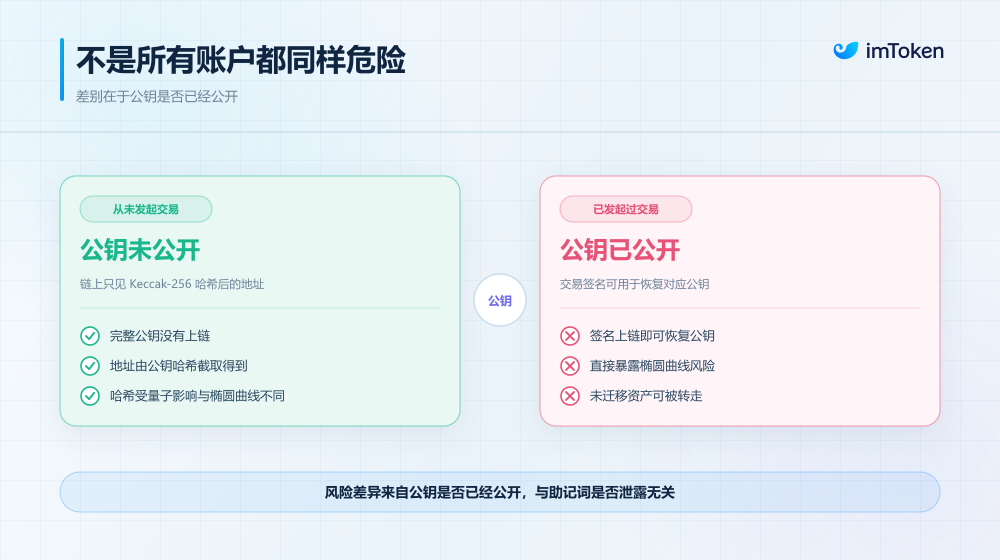
An Ethereum address is derived from a hash of a public key, so exposure is not identical for every account. According to imToken, an account that has never sent an on-chain transaction or disclosed a signature off-chain has not exposed its full public key through those actions. Once an account sends a transaction—even a contract approval—its public key can be recovered from the public signature. That distinction helps explain the long-term risk; it is not a reason to make a hurried transfer today.
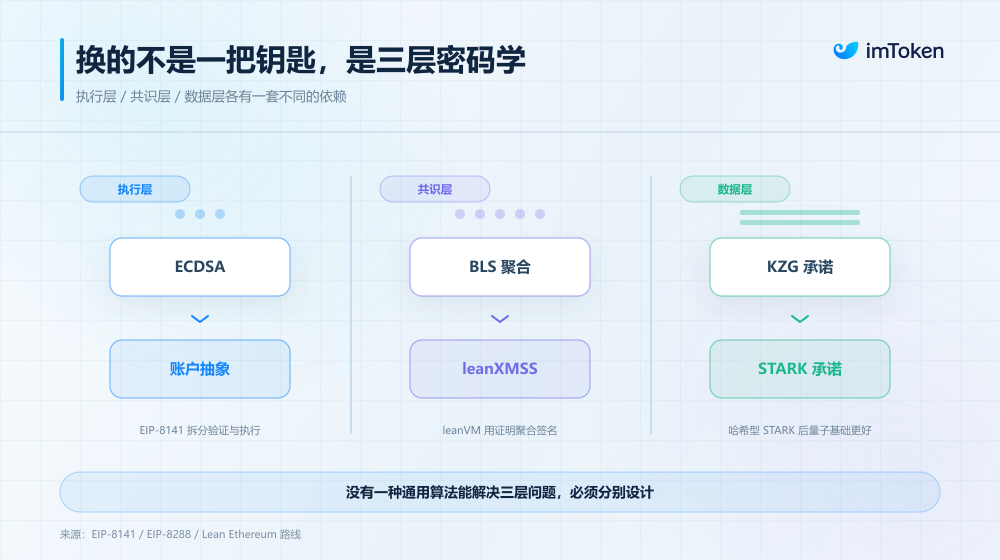
The issue also extends beyond personal wallets. Ethereum’s proof-of-stake validators use BLS signatures, while KZG commitments support blob and rollup data availability. Some application-layer zero-knowledge proof systems rely on mathematical assumptions that would also need review. Hash-based approaches, including STARKs, have different post-quantum properties, but replacing one component does not automatically upgrade the rest of the network.
What Ethereum is exploring
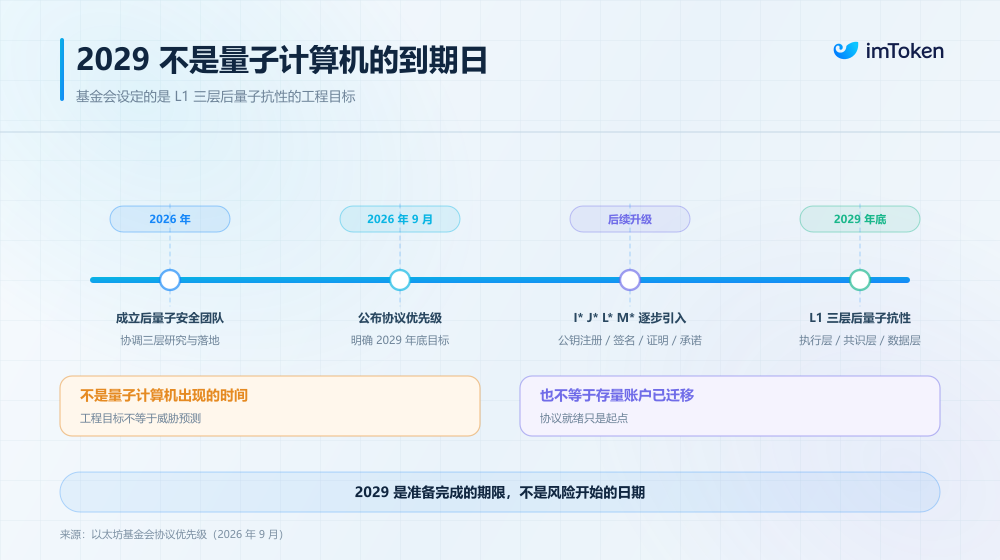
As imToken reported, the Ethereum Foundation formed a Post-Quantum Security team in 2026. Protocol priorities published that September set an engineering goal of post-quantum resistance across Ethereum L1’s execution, consensus and data layers by December 2029. That is a target, not a completed upgrade.
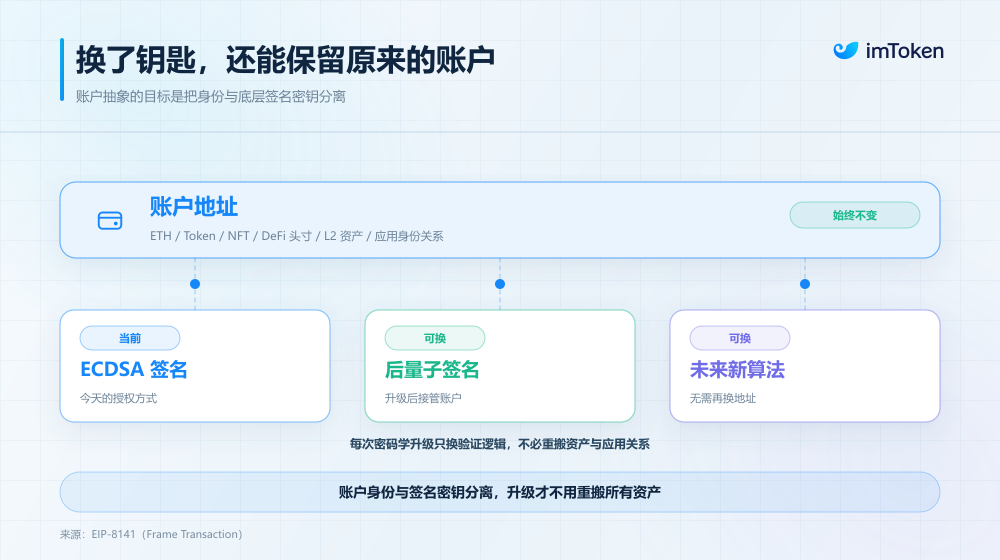
On the execution side, the proposed EIP-8141 would separate parts of transaction validation, execution and gas payment. Programmable account validation could make it possible to change authorization methods without always changing an account’s address. ImToken also described research into precompiles for verifying post-quantum signatures and EIP-8288’s proposal to aggregate verification results using recursive STARKs. These approaches address, in part, the greater data and computation costs of post-quantum signatures.
For consensus, the Lean Ethereum directions discussed in the report include leanXMSS, a hash-based signature approach proposed to replace validator BLS signatures, and leanVM, intended to help aggregate proofs efficiently. The data layer would need attention too: KZG commitments depend on elliptic-curve-related assumptions. None of these proposals means a holder’s wallet has already been converted.
The difficult part: transferring authority safely
A new key does not by itself preserve everything tied to an old address. ImToken pointed to tokens, NFTs, DeFi positions, L2 assets and application-specific permissions or histories as reasons an address change could be complicated. Account abstraction might allow some accounts to retain their identity while changing the keys or validation rules that control them, but that is a prospective capability, not a universal migration path available today.
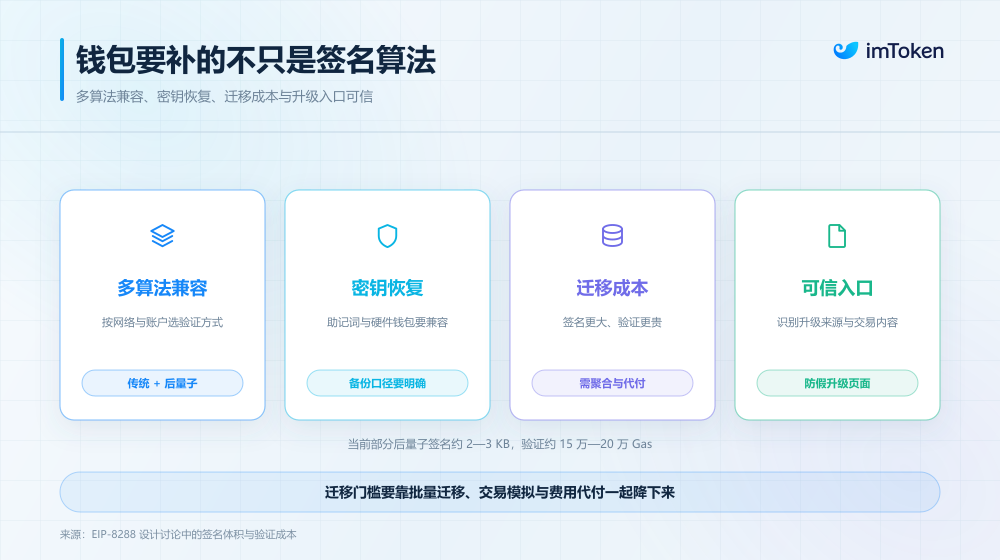
The timing of any migration matters. While an old signing method remains secure, an account holder could authorize a new key under that method. If the old method were already breakable, a valid-looking signature alone might no longer establish whether the holder or an attacker authorized the change. Accounts whose owners have lost their keys, stopped using them or do not know an upgrade is needed present a separate unresolved problem. ImToken described possible future measures, including freezing, as a matter of debate—not an enacted rule.
For holders, the manageable habit is to treat any future upgrade request as an authorization decision. ImToken warned that fraudulent “quantum-safe upgrade,” “private-key verification” or “asset migration” pages could exploit concern about the topic. Check where an upgrade request comes from and what a transaction would authorize; do not enter a recovery phrase into a page claiming it is needed for an upgrade. As of the November 2026 report, imToken’s conclusion was that users did not need to rush to move assets because of quantum computing.