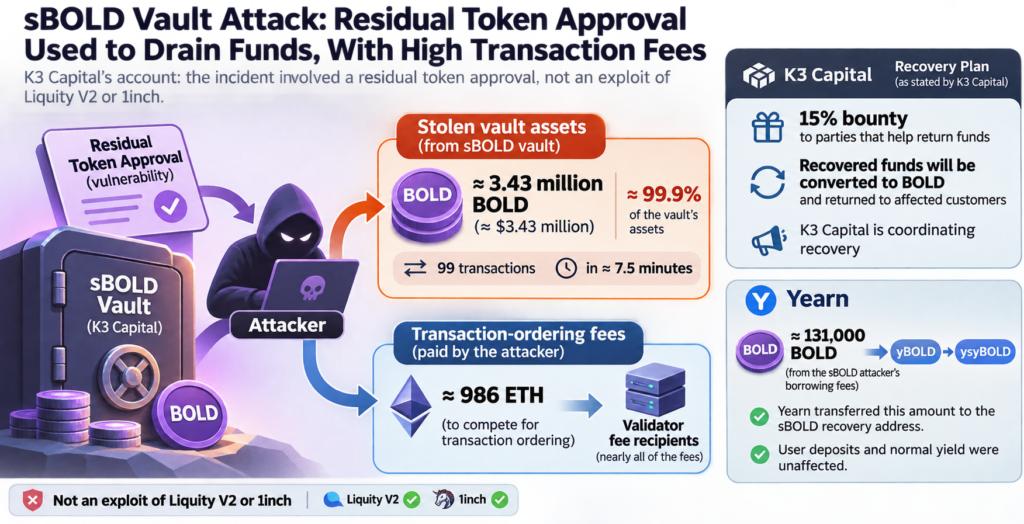
For anyone holding funds in a vault, the concern in this case is a residual token approval—not, according to K3 Capital’s account, an exploit of Liquity V2 or 1inch themselves.
In reporting published on November 20, 2026, K3 Capital said an attacker used that approval vulnerability on November 18 to take approximately 3.43 million BOLD (about $3.43 million) from its sBOLD vault. Its review said the attacker made 99 transactions in roughly 7.5 minutes, taking 99.9% of the vault’s assets.
K3 Capital said the attacker paid about 986 ETH to compete for transaction ordering—more than half the value of the stolen funds—and that nearly all of those payments went to validator fee recipients. K3 Capital is coordinating recovery and offering a 15% bounty to parties that help return funds. It said recovered funds will be converted to BOLD and returned to affected customers; the plan is not a report that those returns have already been completed.
Separately, Yearn said approximately 131,000 BOLD in borrowing fees paid by the sBOLD attacker flowed through yBOLD into ysyBOLD. Yearn said its team transferred that amount to the sBOLD recovery address and that user deposits and normal yield were unaffected.