If you created a Qubic account with the wallet’s built-in seed generator, the important question is how that seed was generated. A later software fix does not change a seed already used to derive an account’s private key.
In its October 20, 2026 report, SlowMist analyzed a weakness in Qubic Wallet’s desktop seed generator and its connection to a network packet field. Qubic had announced on October 18 that an attacker exploited insufficient randomness in some wallet seeds, accessing and transferring about 2.94 trillion QU from 1,404 wallets. SlowMist’s local proof of concept demonstrated a possible private-key recovery path; the report did not establish that this was the method used in every reported theft.
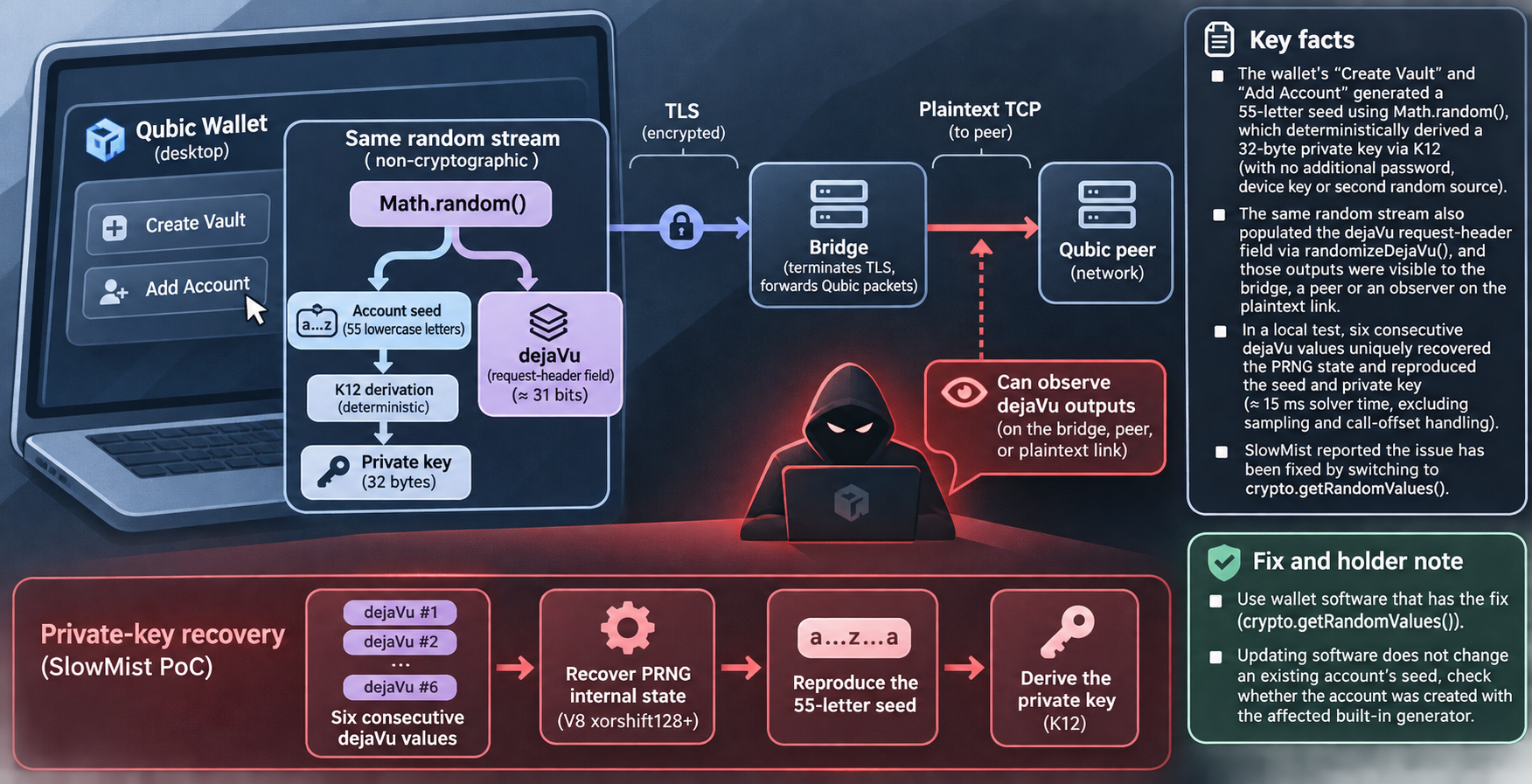
How the two code paths connect
The wallet’s “Create Vault” and “Add Account” flows generated a 55-letter lowercase seed using Math.random(). That seed deterministically produced a 32-byte private key through the wallet’s K12 derivation path; it was not supplemented by a user password, device key or second random source. SlowMist said the affected V8 implementation’s random stream had at most 64 bits of initial entropy, despite the much larger nominal space of 55-letter seeds.
Separately, the @qubic-lib/qubic-ts-library function randomizeDejaVu() used the same random stream to populate a request-header field. The wallet sent requests through a bridge, which terminated TLS and forwarded raw Qubic packets to peers over plaintext TCP. According to SlowMist, the bridge, a peer or an observer on that plaintext link could read these truncated random outputs. Balance requests also carried the user’s public key, allowing candidate seeds to be checked offline.
In a local test modeling the V8 random stream, SlowMist found that six consecutive dejaVu values uniquely recovered its internal state and reproduced the seed and private key. The reported roughly 15-millisecond solver time excluded sampling and call-offset handling. Real-world success would depend on observation access, consecutive and correctly aligned values, and whether other calls consumed the random stream.
SlowMist reported that the issue had been fixed by switching to crypto.getRandomValues(). For holders, the distinction is between checking whether current wallet software uses the fixed generator and determining whether an existing account was created with the affected built-in generator. The report does not establish that updating software alone changes an existing account’s seed.