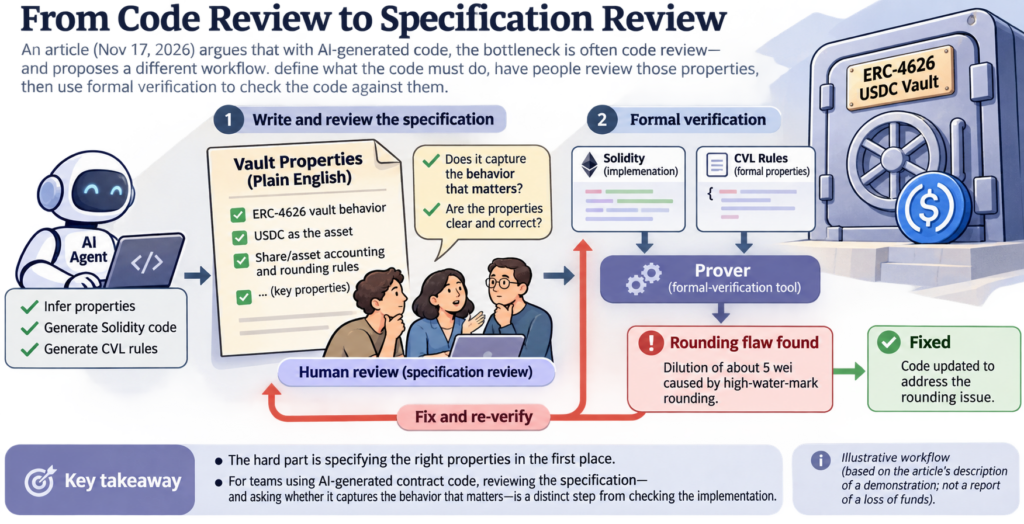
For anyone relying on a crypto vault, the question is not just whether its code has been reviewed, but whether reviewers have clearly defined what the code must do. An article dated November 17, 2026, argues that AI-generated code can make code review a bottleneck. It proposes a different starting point: write the required properties in plain English, have people review them, then use formal-verification tools to check the code against them.
The article describes a demonstration by Certora CEO Mooly Sagiv involving an ERC-4626 USDC vault. An agent inferred properties and generated Solidity code and CVL rules. A prover then found a dilution flaw of about 5 wei caused by high-water-mark rounding; the flaw was subsequently fixed. This was a demonstration, not a reported loss of funds.
The difficult part, the article notes, is specifying the right properties in the first place. For teams assessing AI-generated contract code, reviewing the specification—and asking whether it captures the behavior that matters—is therefore a distinct step from checking whether the implementation satisfies it.