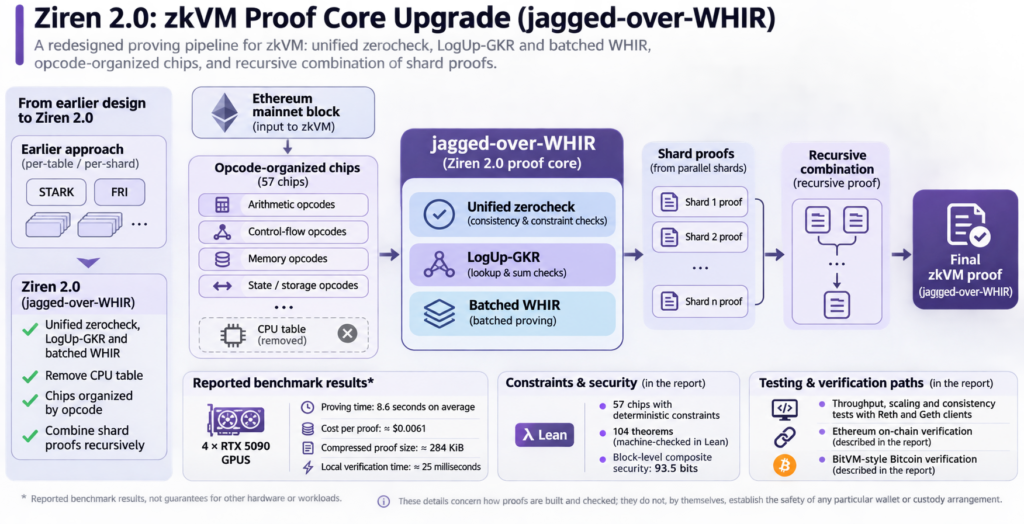
For anyone assessing what a zkVM proof actually guarantees, the proving design and its checked constraints matter more than speed alone. In a report published on November 4, 2026, Ziren 2.0 introduced jagged-over-WHIR as its new proof core. It replaces the earlier per-table or per-shard STARK and FRI approach with unified zerocheck, LogUp-GKR and batched WHIR. The design also removes the CPU table, organizes chips by opcode and combines shard proofs recursively.
According to the project’s benchmarks, proving an Ethereum mainnet block took 8.6 seconds on average using four RTX 5090 GPUs. It reported a cost of approximately $0.0061 per proof, a compressed proof size of approximately 284 KiB and local verification time of approximately 25 milliseconds. These are reported benchmark results, not guarantees for other hardware or workloads.
The report says the deterministic constraints of 57 chips were machine-checked in Lean across 104 theorems, and gives 93.5 bits as the block-level composite security figure. It also presents throughput, scaling and consistency tests involving the Reth and Geth clients, and describes paths for Ethereum on-chain verification and BitVM-style Bitcoin verification. Those details concern how proofs are built and checked; they do not, by themselves, establish the safety of any particular wallet or custody arrangement.