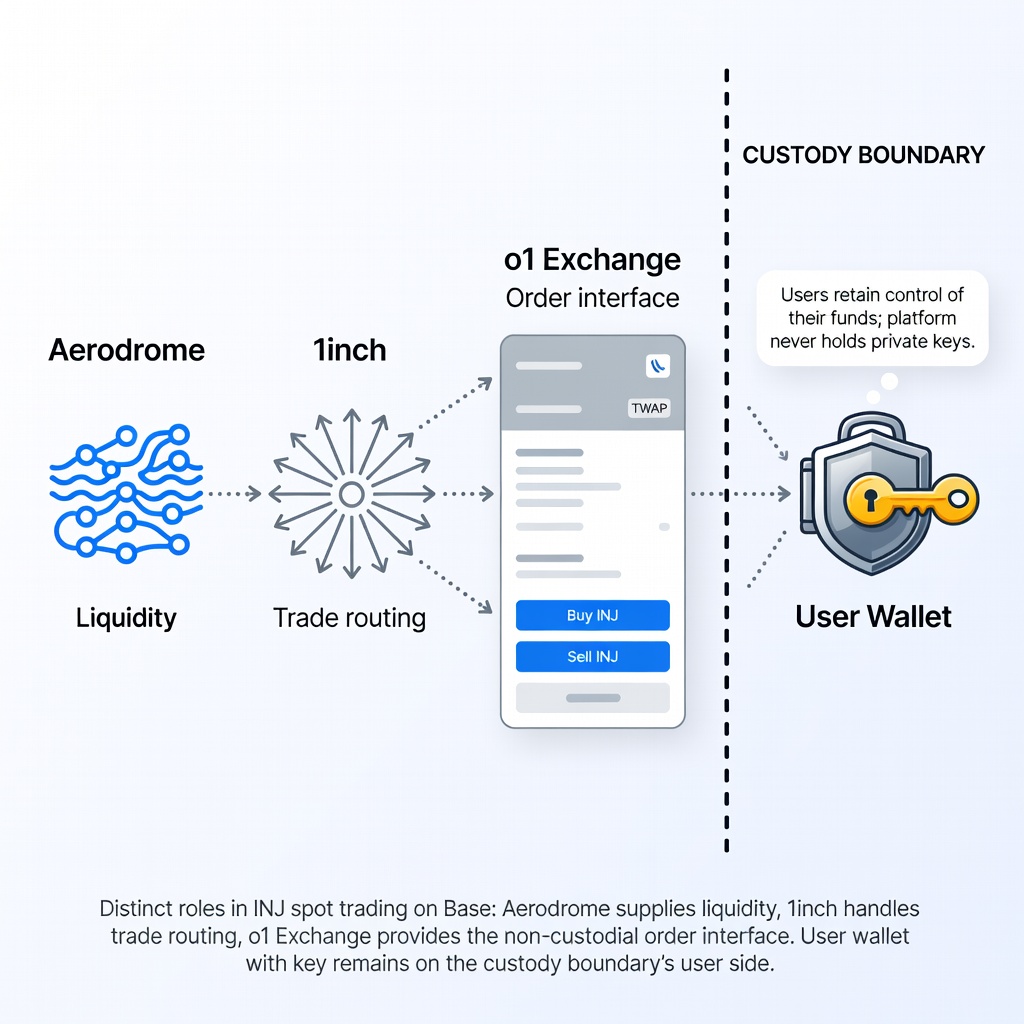
o1 Exchange added spot trading for INJ, Injective’s native token, on November 29, 2026. The listing gives the Base trading terminal’s more than 400,000 beta users access to INJ. o1 describes itself as a non-custodial aggregator of decentralized exchanges: users retain control of their funds, and the terminal does not hold their private keys.
The listing followed Injective’s November 24 launch on Base, Coinbase’s layer-2 network. Each service plays a different role: Aerodrome supplied liquidity from the first day, 1inch handles trade routing, and o1 provides the interface where users place orders.
What the terminal supports
o1 draws on more than 100 liquidity sources and supports other blockchains alongside Base. In its first seven months of beta, it recorded more than $220 million in cumulative spot volume and processed more than 3 million transactions. Those figures cover the platform as a whole, not INJ trading. o1 also ranks among the leading protocols on Base by revenue.
Alongside swaps, o1 offers limit orders and time-weighted average price (TWAP) orders. A TWAP order divides a large trade into smaller trades over a set period to limit its impact on the market price. The terminal also supports perpetuals and has a token launchpad, but the INJ listing is for spot trading. Structured products and on-chain options remain in development.
o1 raised $4.8 million in seed funding, with Coinbase Ventures and a16z among its backers. Its own utility token, $O, is distinct from INJ: it has a fixed supply of 1 billion tokens and gives holders access to trading fee discounts and staking rewards.
For Injective, the Base launch marked the start of a broader multichain expansion. Its separate institutional and compliance efforts include work on CFTC-regulated futures and engagement with the SEC on tokenization initiatives.