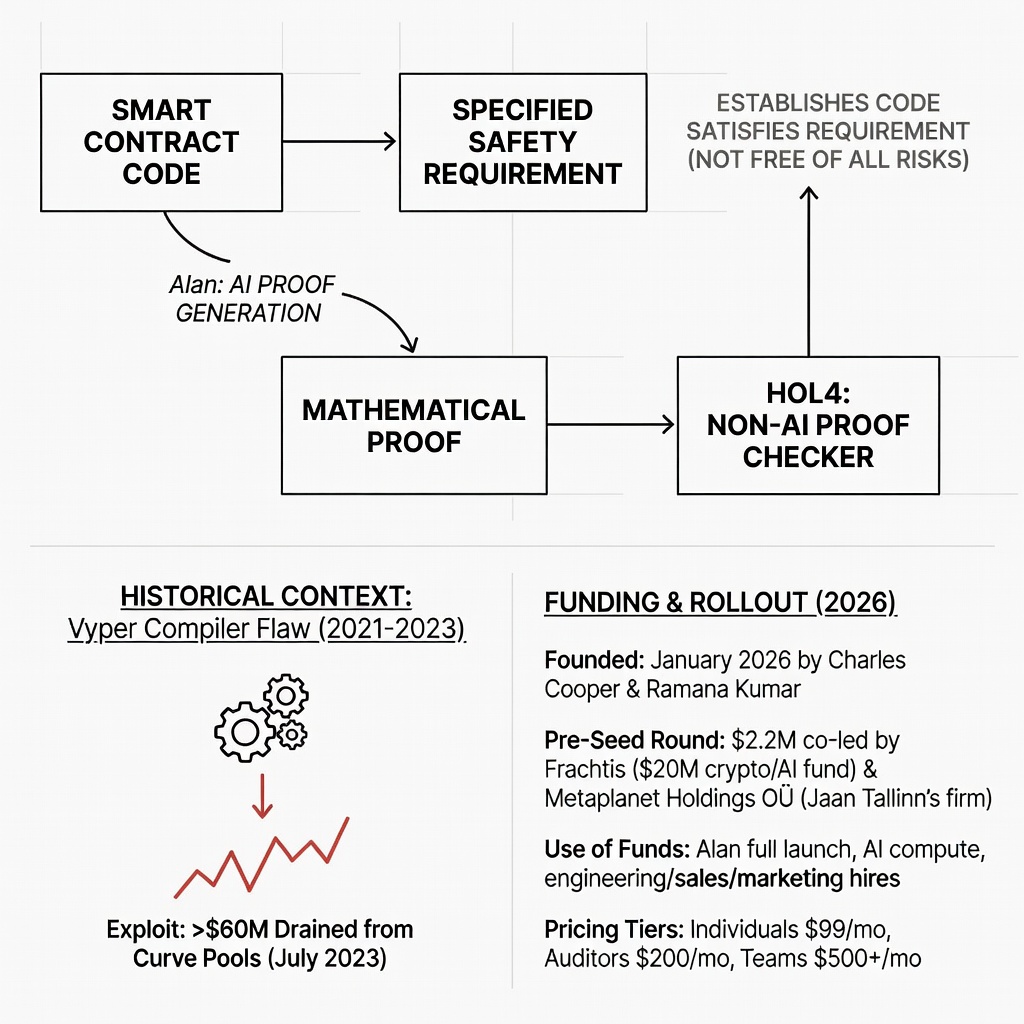
Curve Finance is using Sequent’s verification tool, Alan, to check whether code for its StableSwap pools meets specified safety requirements. The decentralized exchange is the first paying customer of the London startup, which announced a $2.2 million pre-seed round on November 25, 2026.
What Alan checks
Alan uses AI to generate a mathematical proof that a piece of code meets a given requirement. A separate tool called HOL4 checks that proof without relying on AI. The distinction matters for people who hold funds in a pool: a checked proof establishes that the code satisfies the requirement it covers, not that the pool is free of every risk.
Sequent’s focus grew out of its founders’ experience with Vyper, a language used to write Ethereum smart contracts. In July 2023, an exploit drained upwards of $60 million from Curve’s older liquidity pools. A contributing flaw dated to 2021 and lay in the Vyper compiler—the tool that translates developers’ code into instructions that run on the blockchain—rather than in the contract logic Curve’s developers wrote.
Funding and rollout
Charles Cooper and Ramana Kumar founded Sequent in January 2026. Frachtis, a crypto and AI pre-seed fund with $20 million in assets, co-led the round with Metaplanet Holdings OÜ, the investment firm of Skype co-founder Jaan Tallinn.
Sequent plans to use the funding to develop Alan for a full launch, pay for AI computing resources and hire engineering, sales and marketing staff. Monthly pricing starts at $99 for individuals. The auditor tier costs $200 per month, while teams pay $500 or more.