If you hold tokenized securities, or you are trying to understand what would actually pay you when one settles, the open question is not only the token. It is which money moves on the other side, who issues that money, and whether both legs finish together. A Swiss initiative announced on November 24, 2026, is looking at that problem for institutions. It does not hand holders a new wallet, a backup method, or a finished market structure.
A study, not an activated shared ledger
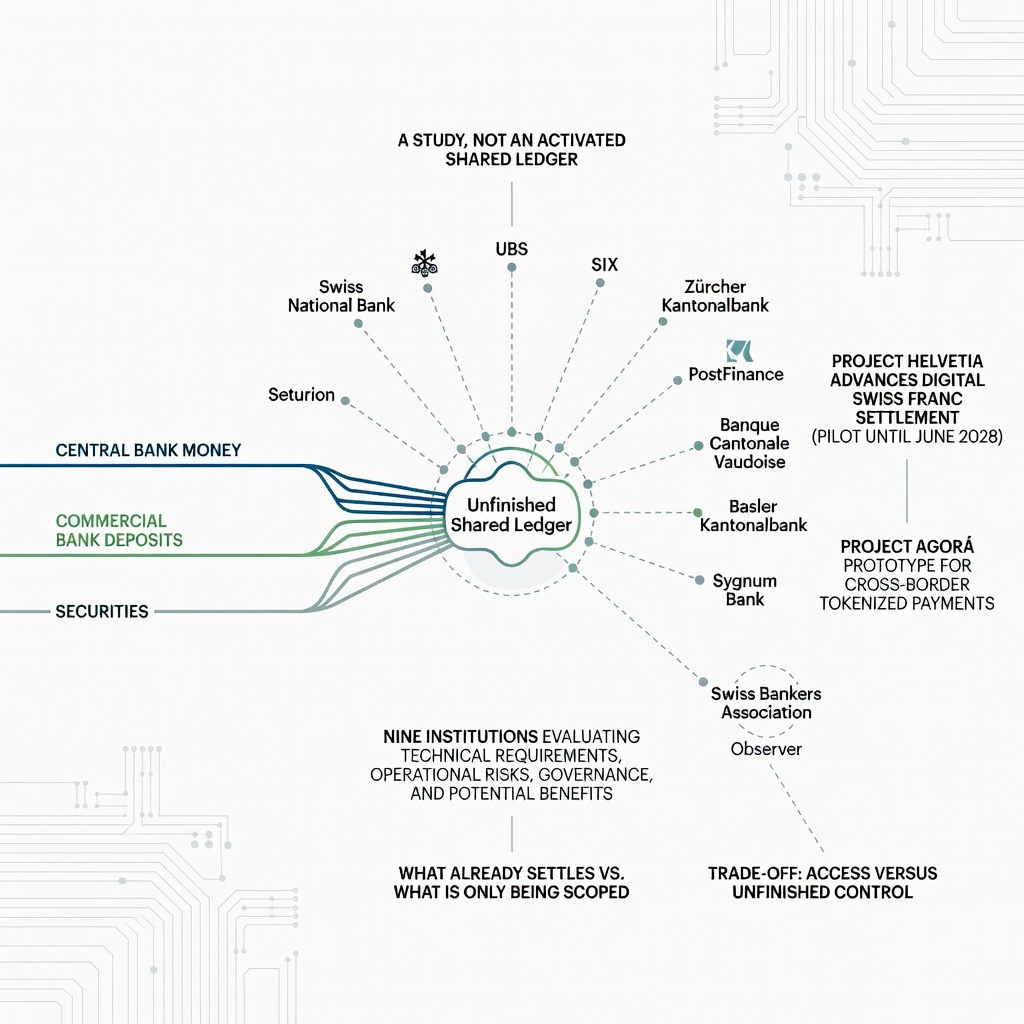
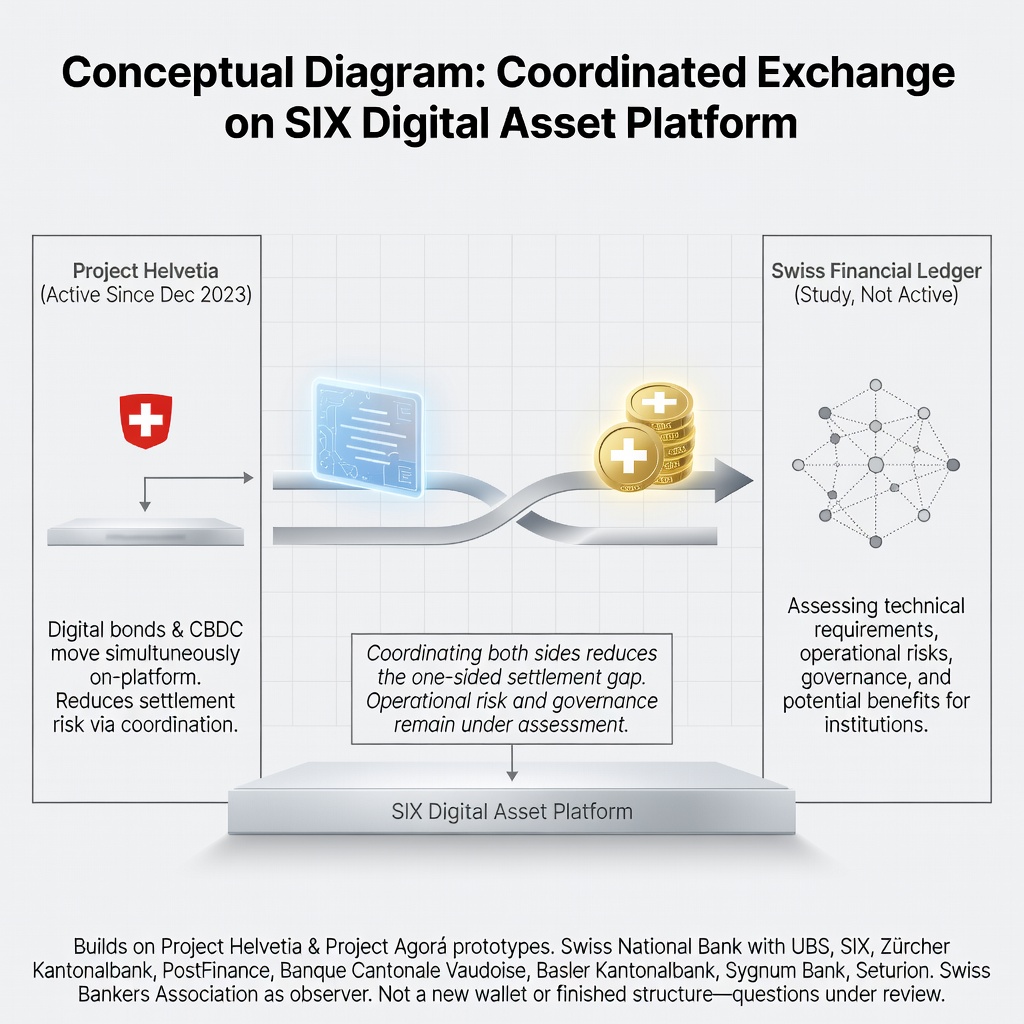
The Swiss National Bank said it is joining eight financial institutions, including UBS and SIX, to explore shared infrastructure for tokenized finance. The Swiss Financial Ledger project will examine settlement opportunities for domestic and international transactions. Together, the nine institutions will evaluate technical requirements for a shared financial platform, along with operational risks, governance structures, and potential economic benefits. Those are questions under review, not rules already in force.
The institutions are the Swiss National Bank, UBS, SIX, Zürcher Kantonalbank, PostFinance, Banque Cantonale Vaudoise, Basler Kantonalbank, Sygnum Bank, and Seturion. They will look at how central bank money, commercial bank deposits, and securities can interact through distributed ledger technology. They have established the Helvetia Strategic Board to coordinate discussions. The Swiss Bankers Association will participate as an observer, not as one of the nine institutions carrying out the assessment.
For anyone thinking about how assets are held and settled, the trade-off is access versus unfinished control. A shared platform could make settlement more consistent across institutions. It could also put technical design, operational risk, and governance in one place before those choices are settled. The announcement treats the economic benefits as potential.
What already settles, and what is only being scoped
The new work builds on Switzerland’s existing digital-settlement experiments under Project Helvetia. The Swiss National Bank began issuing wholesale central bank digital currency under that project in December 2023. Financial institutions access digital Swiss francs through the regulated SIX Digital Asset Platform and use them to settle transactions in tokenized securities. Participating banks can already settle tokenized bond transactions with those digital francs.
In that on-platform model, digital bonds and central bank money can move at the same time. Buyers receive the securities while sellers receive payment inside the same infrastructure. The arrangement is described as reducing settlement risk by coordinating both sides of a transaction. That is narrower than removing risk. The shared-ledger group is still assessing operational risks and governance, and access still runs through a regulated platform.
Central bank money is described as a settlement asset without private-issuer credit risk. That point is about who stands behind the cash leg. It is not a statement about market prices, and it does not mean a custody setup is free of operational or access failure.
Project Helvetia is also testing another method through the Swiss Interbank Clearing system. In that test, SeturionX settles digital assets on Ethereum, while the existing interbank system processes the corresponding payments. The asset leg and the cash leg are on different systems, so a holder cannot treat them as one venue. The central bank will continue the pilot until at least June 2028.
Cross-border work, and projects that are not this ledger
The Swiss Financial Ledger also builds on Project Agorá, an international initiative involving central banks and private financial institutions. Agorá examines faster, cheaper, and safer cross-border payments through tokenization. Its prototype has already supported real-value transactions involving multiple currencies and participating institutions. That claim is about the Agorá prototype. It is not a claim that the Swiss shared ledger has processed payments.
The new initiative addresses the difficulty of connecting separate digital financial platforms. A shared infrastructure could reduce settlement fragmentation and improve coordination between institutions. Both outcomes are stated as possibilities, not as measured results.
Swiss institutions have also pursued separate digital-payment work. Earlier in 2026, six major Swiss banks introduced a Swiss-franc stablecoin sandbox. Separately, UBS recently used Chainlink technology to automate processes involving tokenized structured notes on Ethereum. Neither project is the Swiss Financial Ledger. A privately issued franc instrument and wholesale central bank money do not carry the same issuer.
Checks the announcement actually supports
This is wholesale market infrastructure. It is not personal backup planning, and it does not collect or replace anyone’s recovery secrets. If you are judging how a tokenized Swiss position would settle, the announcement supports only a few distinctions:
- Whether the cash leg is digital central bank money on the SIX Digital Asset Platform, or a payment through Swiss Interbank Clearing while SeturionX settles the digital asset on Ethereum.
- Whether a description refers to the Helvetia pilot already in use, or to the shared-ledger study that is still defining technical requirements, governance, and potential benefits.
- That the pilot is set to continue at least until June 2028, and that the Swiss Bankers Association’s role is as an observer.
A coordinated exchange can shorten the period in which one side has delivered and the other has not. On the facts announced, it does not remove issuer, operational, or governance risk.