
For readers considering whether to hold an election contract to settlement, the distinction between a market’s overall accuracy and an individual wallet’s outcome matters. An Anti-Corruption Data Collective (ACDC) brief published on November 23, 2026, found that prediction markets performed about as well as established forecasting models in that year’s U.S. midterm congressional races. Its analysis of Polymarket wallets found that profits were heavily concentrated.
Accuracy depended on the race
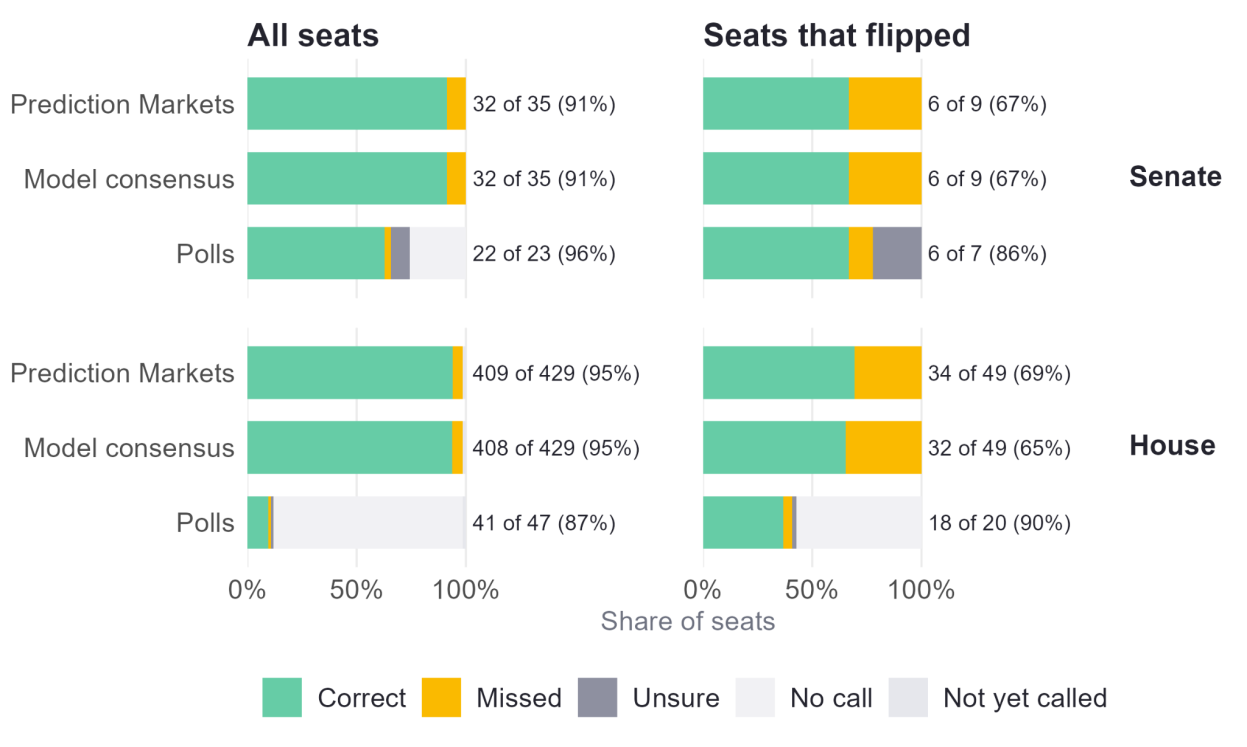
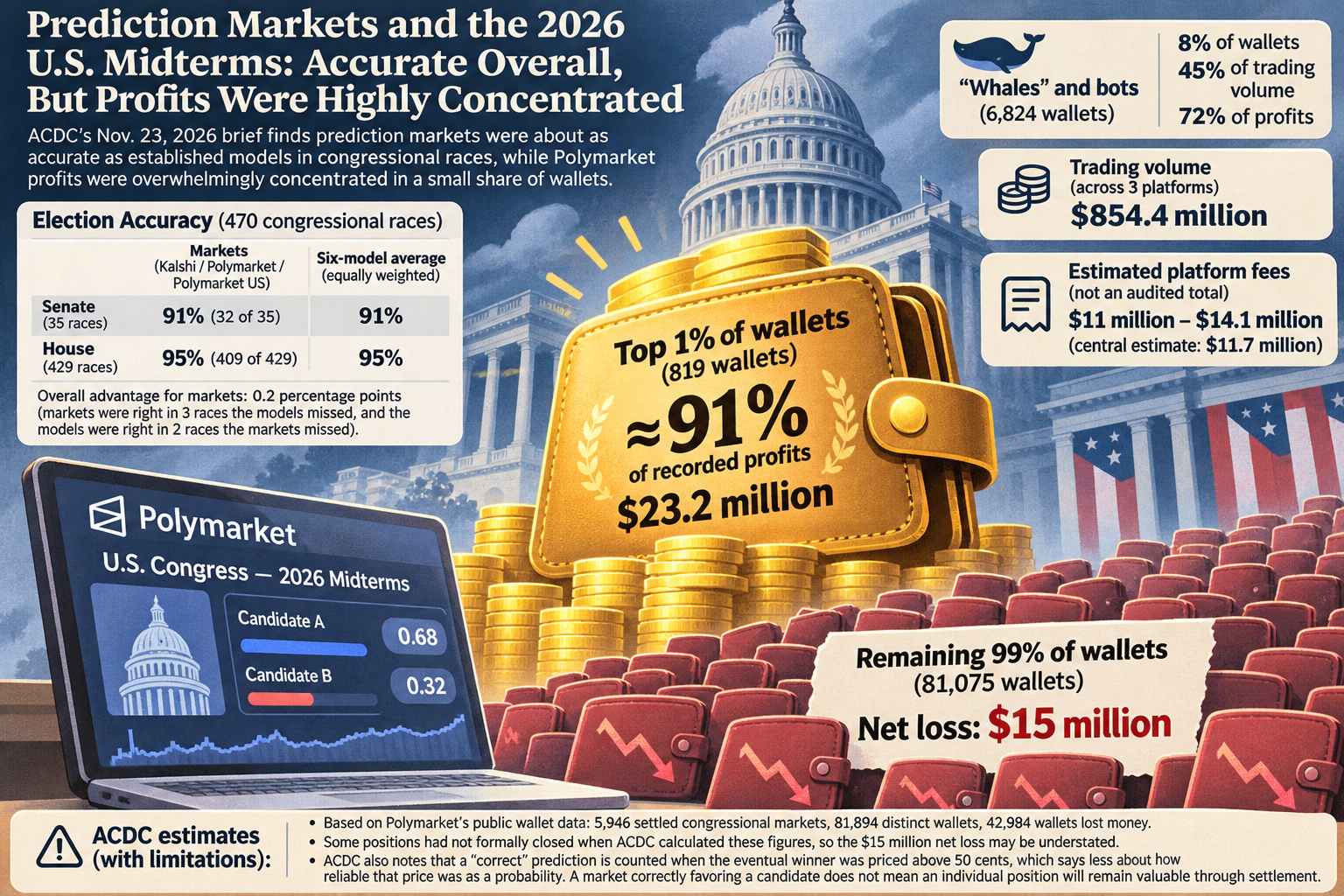
ACDC assessed contract prices 24 hours before the first polling station opened, counting a prediction as correct when the eventual winner was priced above 50 cents. Of 470 congressional races, 464 had been decided by November 19. Across Kalshi, Polymarket and Polymarket US, the markets correctly called 32 of 35 Senate races and 409 of 429 House races—91% and 95%, respectively. An equally weighted average of six forecasting models achieved the same rounded accuracy rates.
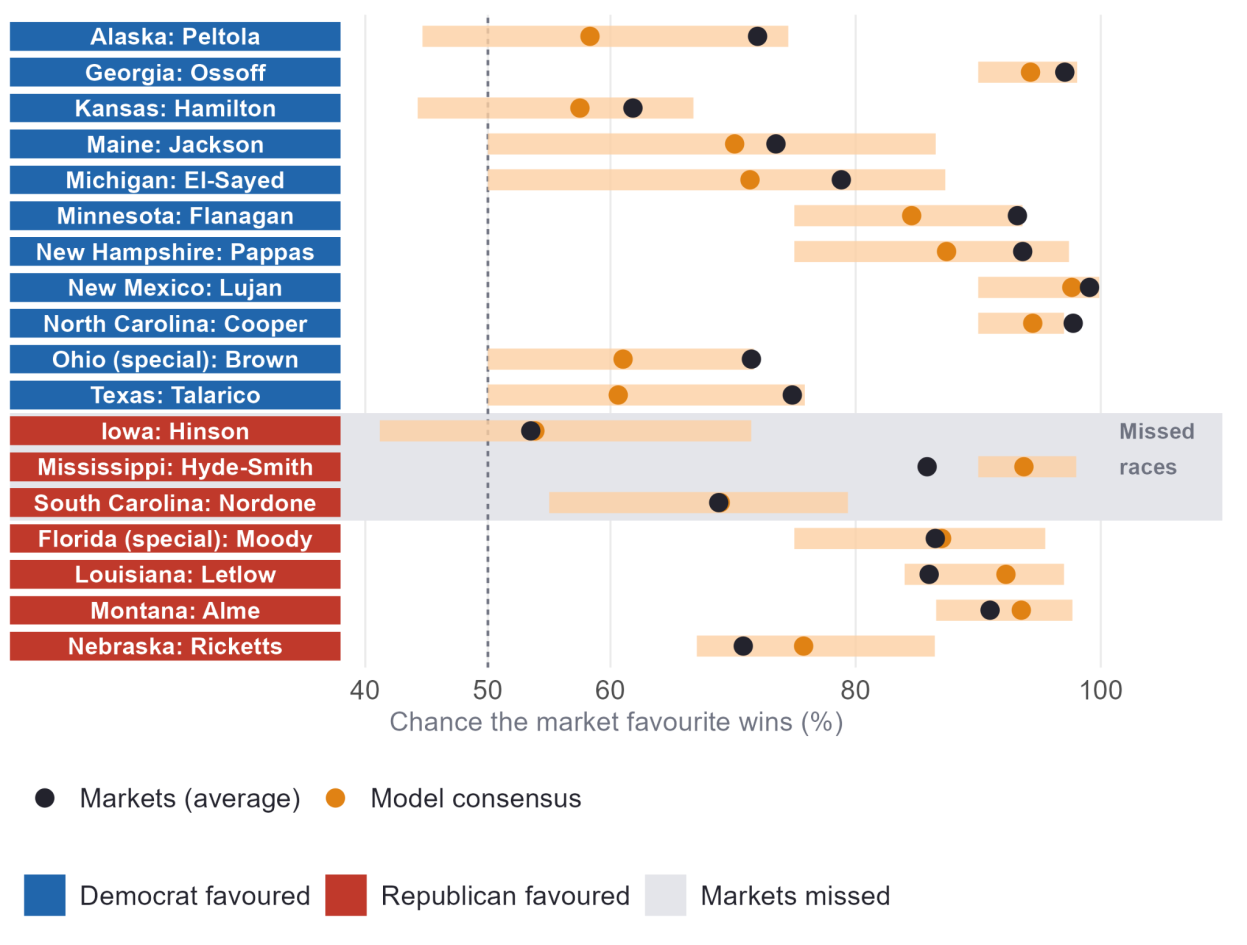
The comparison was closer than the headline percentages suggest: markets were right where the models were wrong in three races, while the models were right where markets were wrong in two. ACDC characterized the markets’ overall advantage as 0.2 percentage points.
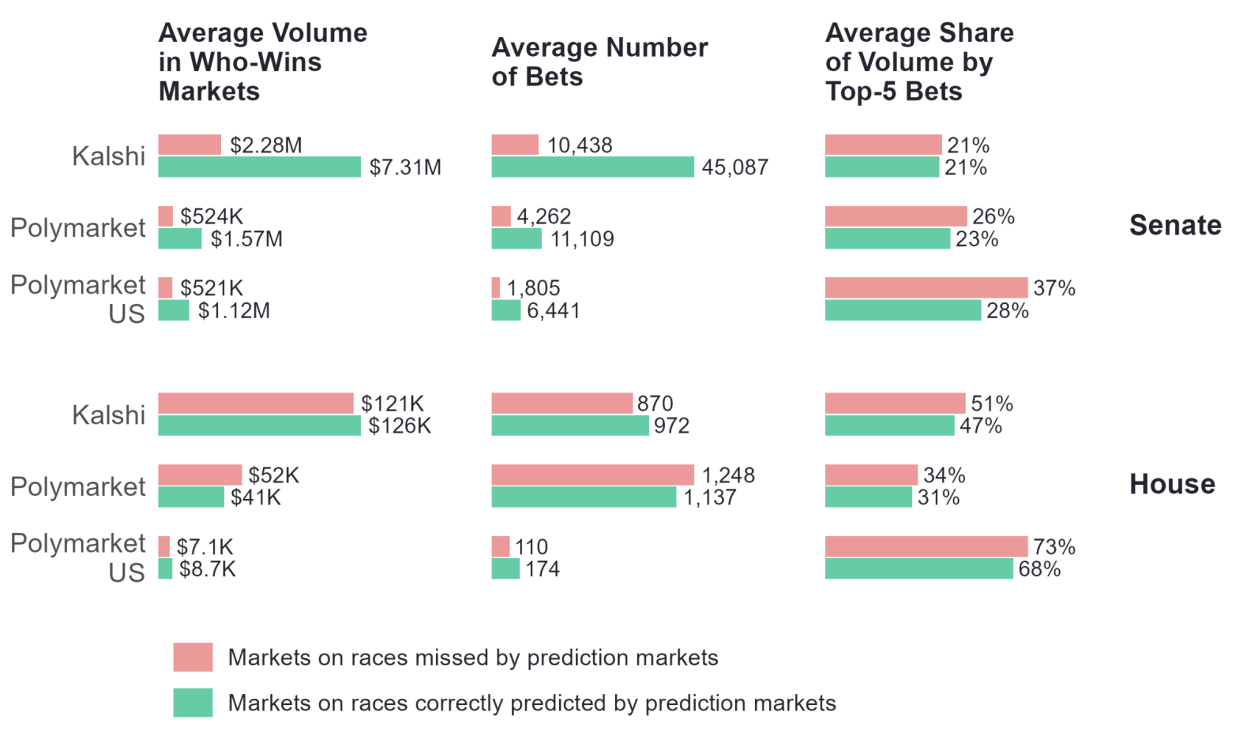
The hardest races produced a less reassuring result. Among races with a leading candidate priced below 65 cents, Kalshi called 10 of 24 correctly, Polymarket US 11 of 25, and Polymarket 13 of 25. But a separate comparison of seats that changed party control showed a slight market advantage over the model consensus in House races. Those smaller groups do not support a sweeping claim that markets consistently outperform—or fail at—close calls.
What the wallet data shows
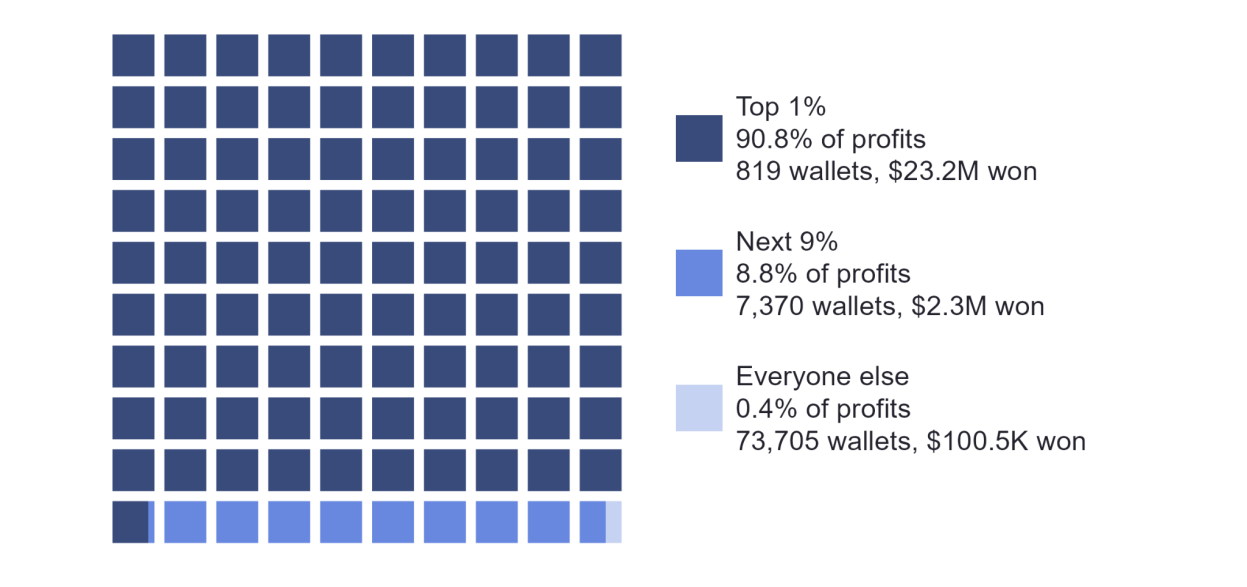
Only Polymarket provided the public wallet-level trading and profit data used for ACDC’s distribution analysis. Across 5,946 settled congressional markets involving 81,894 distinct wallets, 42,984 wallets lost money. The top 1%, or 819 wallets, received roughly 91% of recorded profits, totaling $23.2 million; the remaining 99% collectively had a net loss of $15 million. ACDC cautioned that some positions had not formally closed when it calculated those figures, so the net loss may be understated.
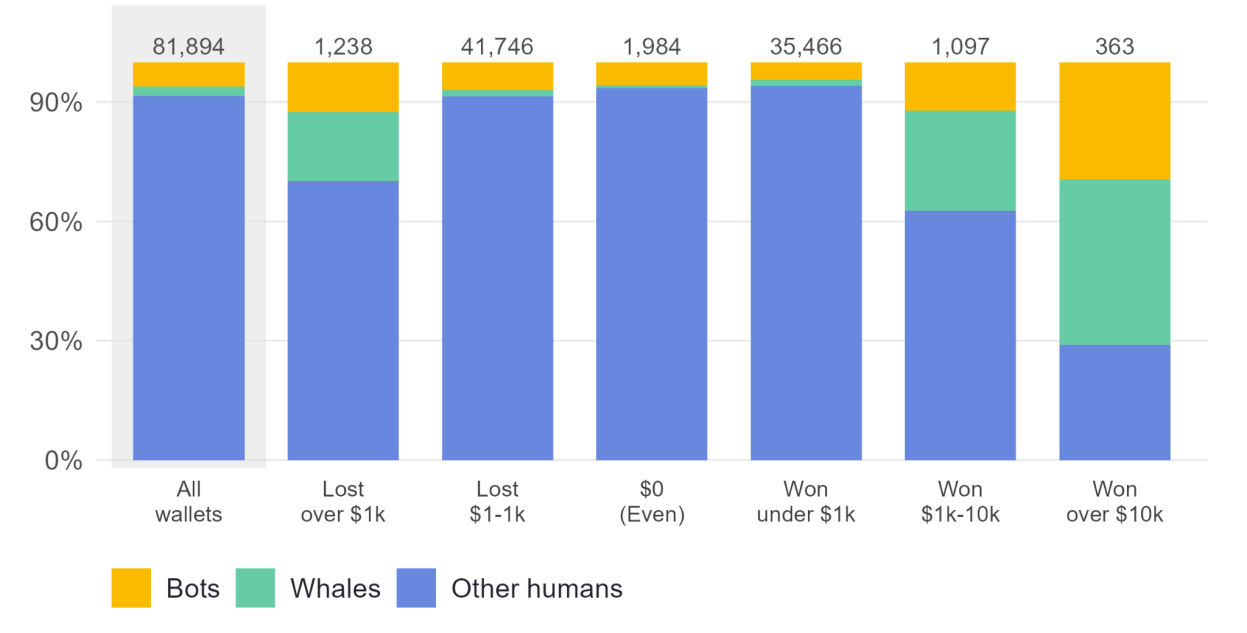
ACDC classified 6,824 wallets as either high-volume “whales” or bots under its stated activity criteria. Together they represented 8% of wallets, 45% of trading volume and 72% of profits. These are wallet classifications, not a count of identified people. The report also found that ordinary users made money during trading but suffered their largest losses at settlement when losing contracts they still held paid out nothing.
Fees and limits of the findings
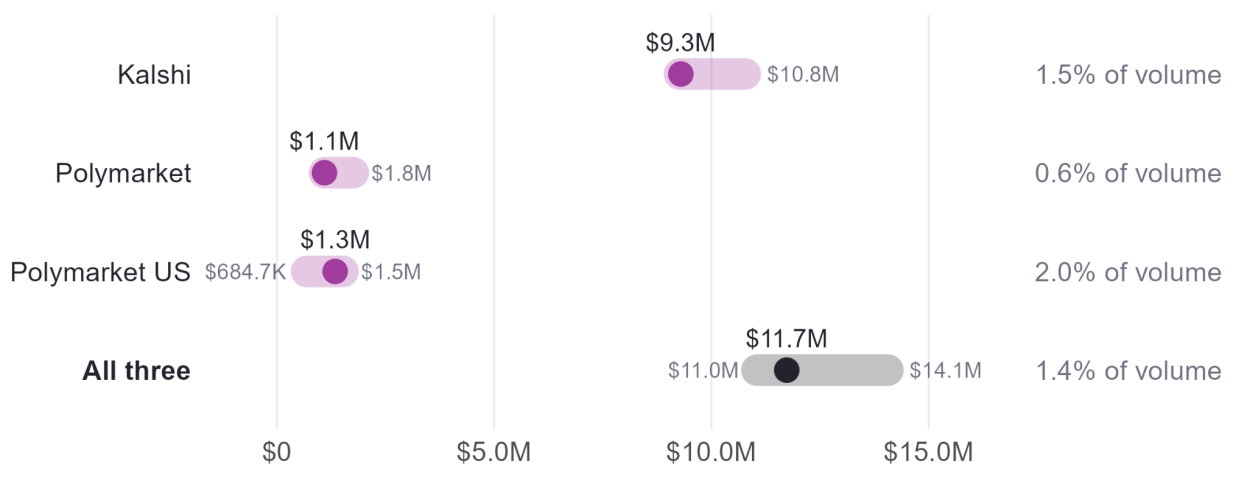
The three platforms recorded a combined $854.4 million in congressional-seat trading volume. Using daily fee schedules, ACDC estimated platform fees at $11 million to $14.1 million, with $11.7 million its central estimate—not an audited total. Trading losses from a wrong prediction do not themselves go to the platform; fees and contract payouts are different flows of money.
ACDC advocates returning prediction-market jurisdiction to U.S. states, and its co-founder David Szakonyi called for Congress to prohibit election betting. That policy position is a proposal, not an enacted rule. The brief’s accuracy measure also counts a 51-cent favorite as a correct call, which says less about how reliable that price was as a probability. For a contract holder, the report’s practical distinction is between a market correctly favoring a candidate and a particular position remaining valuable through settlement.