
A shielded transaction does not necessarily hide the network connection used to make it. For someone holding ZEC in a mobile wallet, the practical question is whether the server handling wallet requests can also see their IP address.
As reported on November 11, 2026, Zodl—the Zcash wallet formerly known as Zashi—was rolling out an OHTTP-based server architecture with version 3.20.0. The protection is enabled by default, with the upgrade being released to users in stages at the time of reporting.
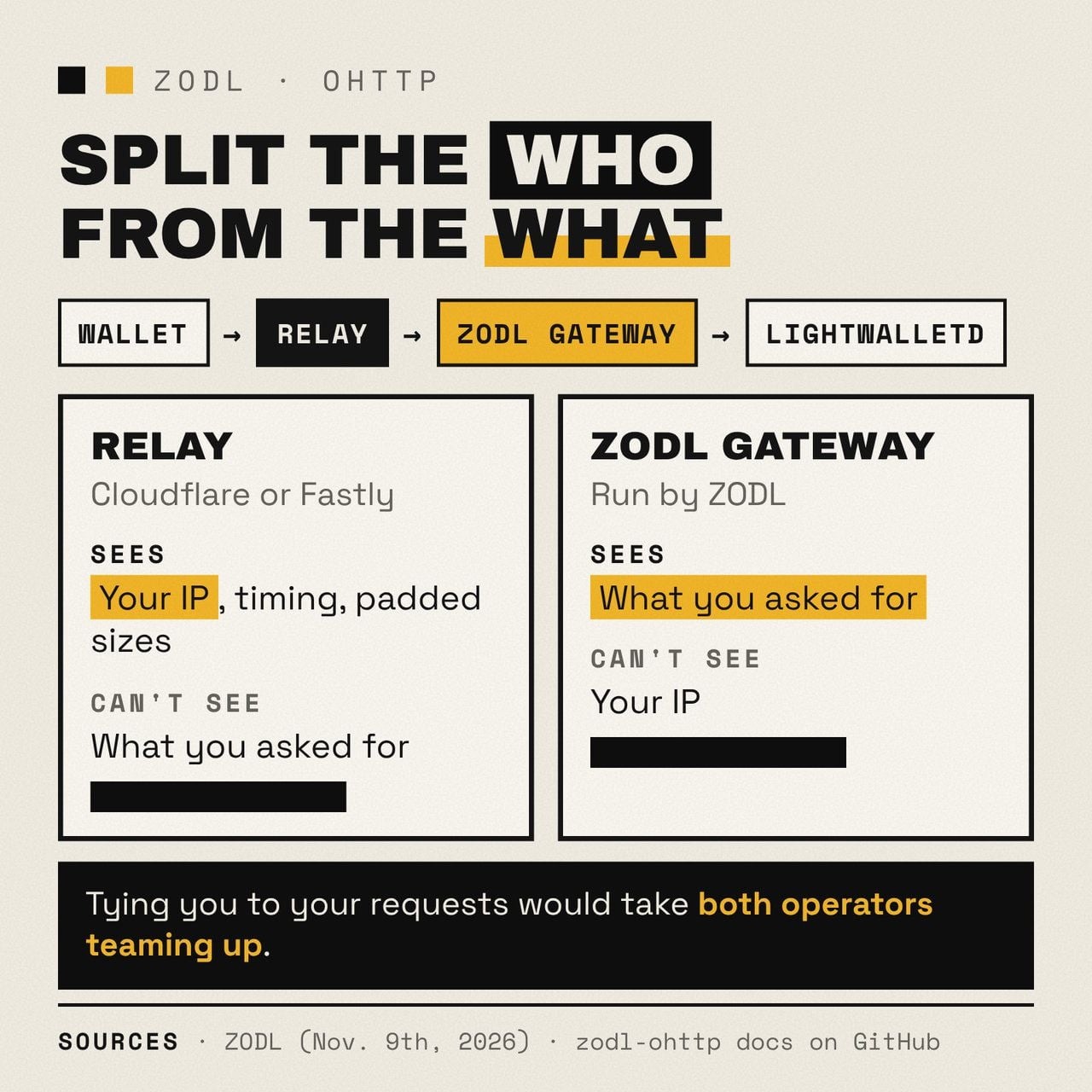
What the new route separates
Light wallets rely on remote servers to retrieve blockchain data and broadcast transactions. A conventional connection can reveal a user’s IP address, request and timing to the server, even when the activity on-chain is shielded.
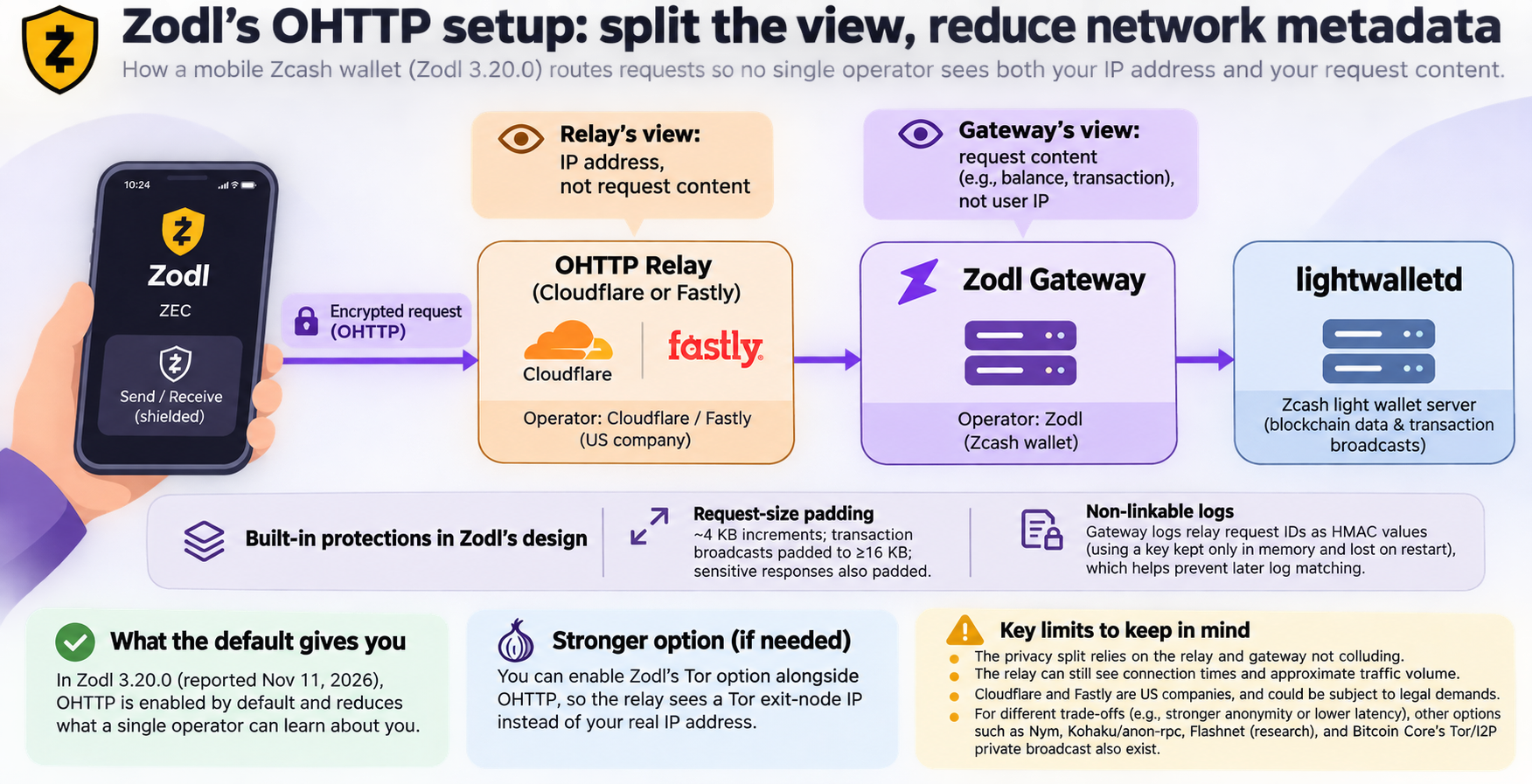
Zodl’s design splits the connection between two operators. The wallet encrypts its request for a Zodl gateway, then sends it through a relay operated by Cloudflare or Fastly. The relay can see the user’s IP address but cannot read the encrypted request. The Zodl gateway can read the request and pass it to lightwalletd, but sees the relay’s address rather than the user’s IP. Neither operator is meant to hold both pieces of information on its own.
The published code also includes request-size padding, with roughly 4 KB size increments and transaction broadcasts padded to at least 16 KB. Sensitive responses receive padding too. To limit later log matching, the gateway records relay request IDs as HMAC values calculated with a key held only in its memory and lost on restart.
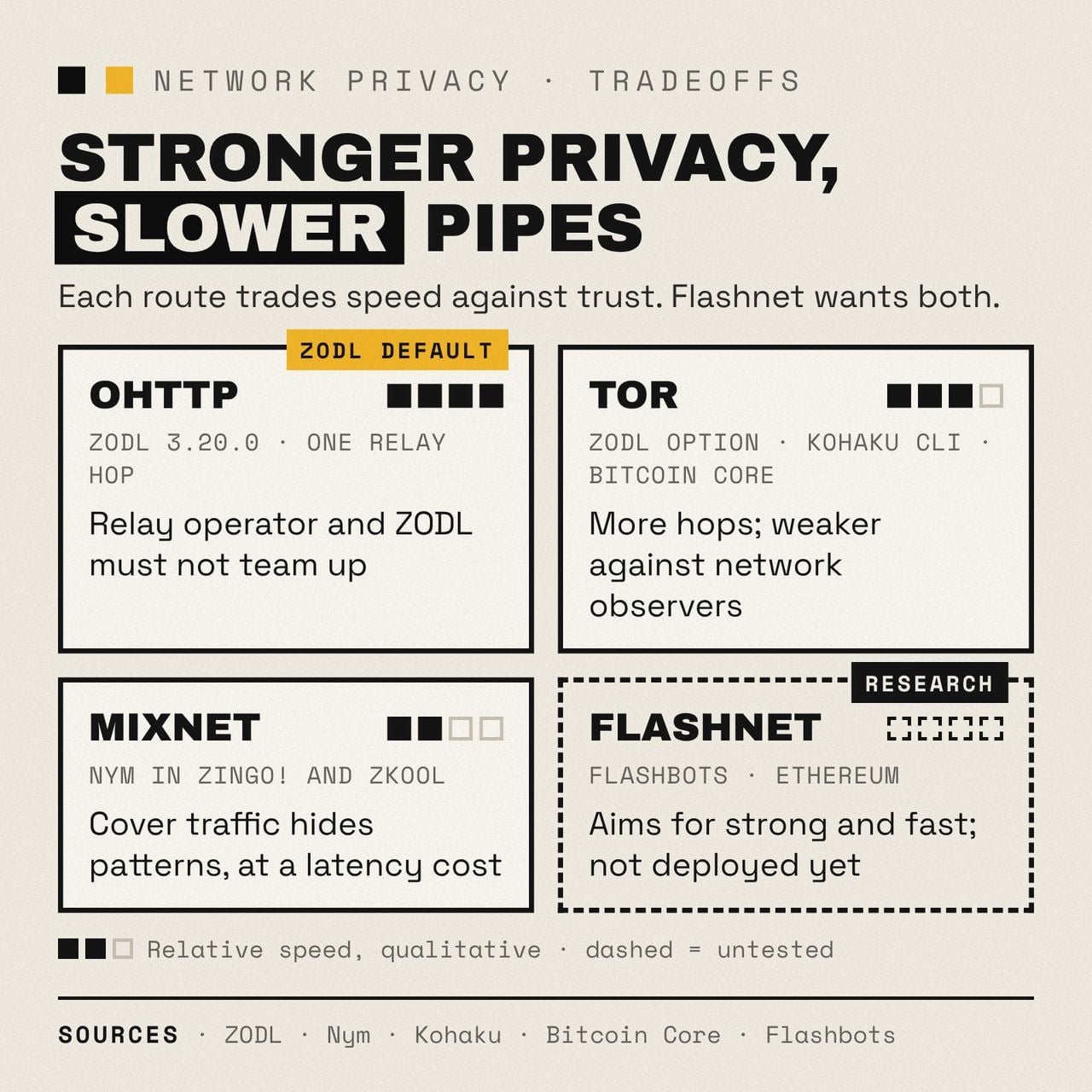
What the default does not protect against
This separation depends on the relay and gateway not colluding. The relay can still observe connection times and approximate traffic volume. Zcash community critics also raised concerns about relying on Cloudflare and Fastly, both US companies subject to legal demands.
Zodl core contributor y4ss acknowledged the limit: OHTTP is a better default, not a replacement for Tor or Nym against a powerful state-level adversary. For users whose threat model includes legal pressure on cloud infrastructure, y4ss suggested enabling Zodl’s Tor option alongside OHTTP. In that setup, the relay would see a Tor exit-node IP rather than the user’s own address. Zodl also allows users to switch back to community nodes in advanced settings.
Other approaches, different trade-offs
Network-metadata protection is not confined to Zodl. Nym said in September 2026 that its mixnet had been integrated into the Zingo and Zkool Zcash wallets; the extra routing and obfuscation come with added latency. Ethereum’s Kohaku command-line tool routes traffic other than calls to a self-hosted local RPC through Tor by default. The Ethereum Foundation’s anon-rpc proposal aims to give wallets a common interface for anonymous networks; a version supporting Tor and Nym was running on mainnet and had been adopted by the Privacy Pools v2 web interface at the time of reporting.
Flashbots’ Flashnet remained a research approach to anonymous Ethereum transaction submission, with no formal mainnet deployment or benchmark results reported. On Bitcoin, Core 31.0 added an optional private-broadcast feature using Tor or I2P and a separate connection for each transaction. A disclosed fallback flaw that could expose a sender’s IP after a failed anonymous handshake was fixed in version 31.1.
The holding habit is to check which network-privacy option a wallet actually enables, rather than assume on-chain shielding covers the connection to its server. Zodl’s default reduces what one operator can learn, but it does not remove every trust or availability risk.