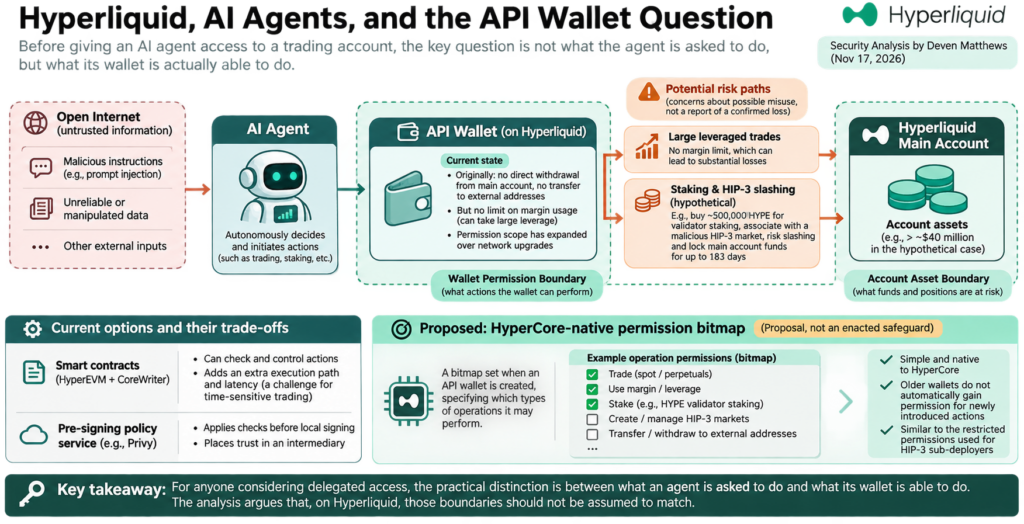
Before giving an AI agent access to a trading account, the holding question is what that access actually permits. In an analysis published on November 17, 2026, Deven Matthews argued that Hyperliquid’s API wallets lack the fine-grained controls needed to limit an agent to specific actions—and that their scope has expanded as the network has added features. These are concerns about possible misuse, not a report of a confirmed loss.
Where the boundary may fail
API wallets were originally restricted from withdrawing directly from a main account or transferring to external addresses, Matthews wrote. But, he argued, they had no limit on how much margin they could use. That leaves a potential route for losses through leveraged trades even without direct withdrawal access.
Matthews also described a hypothetical case involving a main account with more than approximately $40 million in assets. He said a compromised API wallet could buy 500,000 HYPE for validator staking, associate the stake with a malicious HIP-3 market, expose it to slashing and lock the main account’s funds for up to 183 days. The article does not establish that this scenario has occurred.
An agent creates another trust boundary: it may act on information from the open internet. Matthews warned that malicious instructions placed in an agent’s decision-making context could cause it to initiate harmful actions without an attacker obtaining the API wallet’s private key.
A proposed restriction, not a current safeguard
Matthews said smart-contract controls through HyperEVM and CoreWriter can check actions, but the additional execution path creates latency for time-sensitive trading. He noted that a service applying checks before local signing, such as Privy, instead places trust in an intermediary.
His proposed change is a HyperCore-native bitmap set when an API wallet is created. It would specify which types of operations that wallet may perform; older wallets would not automatically gain permission for newly introduced actions. Matthews compared the approach with restricted permissions used for HIP-3 sub-deployers. This is a proposal, not an enacted API-wallet permission system.
For anyone considering delegated access, the practical distinction is between what an agent is asked to do and what its wallet is able to do. The analysis argues that, on Hyperliquid, those boundaries should not be assumed to match.