
For anyone with a position in HARD Lend, the immediate concern is the lending pool—not the security of every asset on Kava Chain. In a report published November 16, 2026, at 19:37 (UTC+8), Kava said an attacker had removed approximately 53.9 million KAVA, valued at about $1.83 million, from the application’s lending pool.
How Kava described the attack
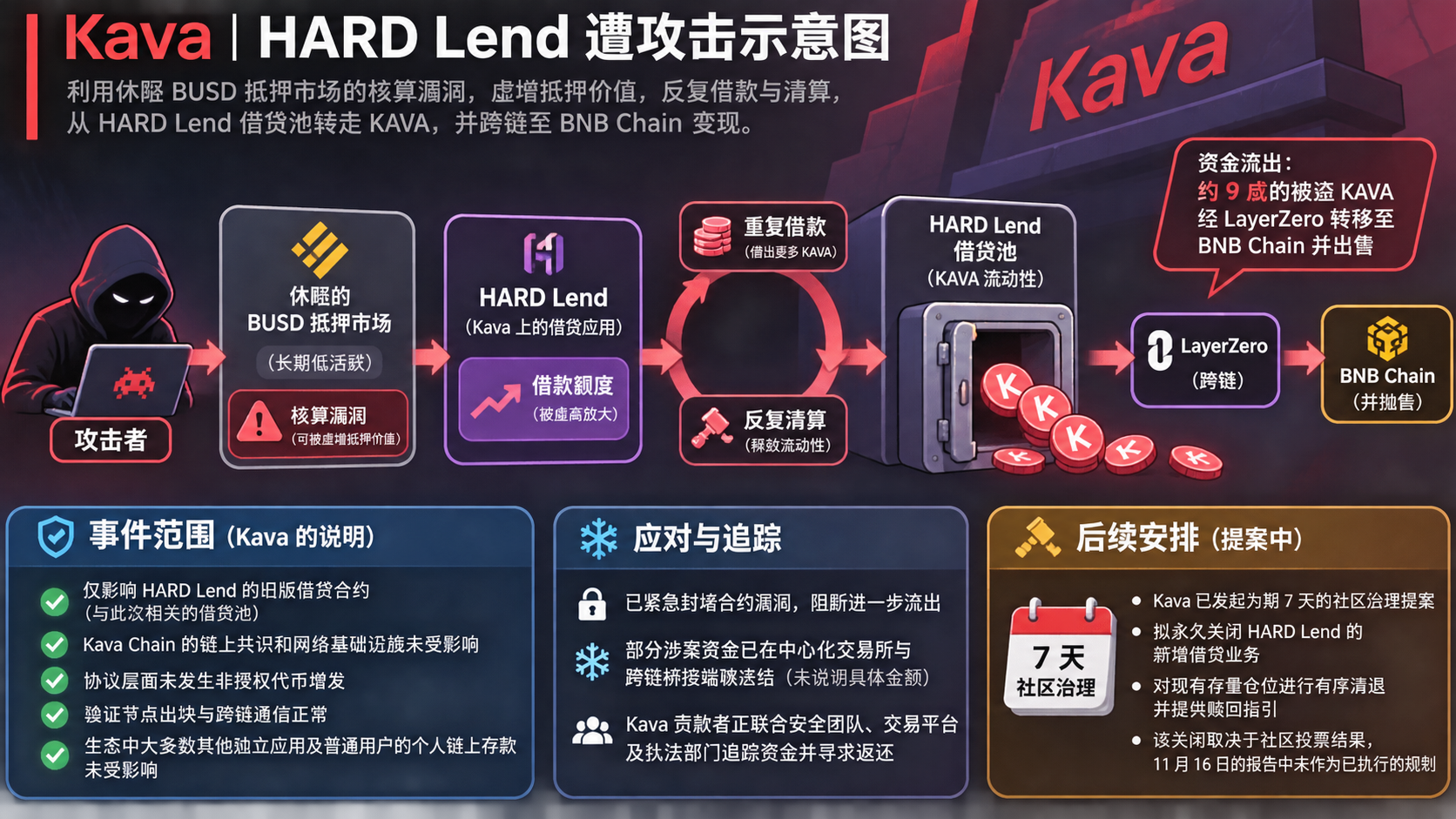
According to Kava’s security update, the attacker exploited an accounting flaw in a dormant BUSD collateral market. By inflating the recorded value of collateral in a lending account, the attacker could repeatedly borrow and liquidate positions, draining available liquidity from the pool.
The report says on-chain data showed that approximately 49.2 million of the removed KAVA—91.28%—was subsequently transferred to BNB Chain through LayerZero and sold. Kava said it had blocked the contract vulnerability and that some funds had been frozen at centralized exchanges and cross-chain bridging endpoints as of November 16. It did not specify the frozen amount. Kava contributors were working with security teams, exchanges and law enforcement to trace funds and seek their return.
Kava said the incident was confined to HARD Lend’s older lending contracts: its chain consensus and network infrastructure were unaffected, no unauthorized tokens were issued at the protocol level, and validators and cross-chain communication continued operating. It also said the vast majority of other independently deployed applications and ordinary users’ personal on-chain deposits were unaffected. Those are Kava’s stated boundaries for the incident, not a guarantee that HARD Lend positions are unaffected.
What remains proposed
Kava launched a seven-day community governance proposal to permanently stop new HARD Lend lending and phase out existing positions with redemption guidance. That shutdown depended on the vote; it had not been presented as an enacted rule in the November 16 report. For existing positions, the relevant next step is to follow the project’s official governance outcome and any subsequent redemption instructions rather than assume withdrawals have already been resolved.