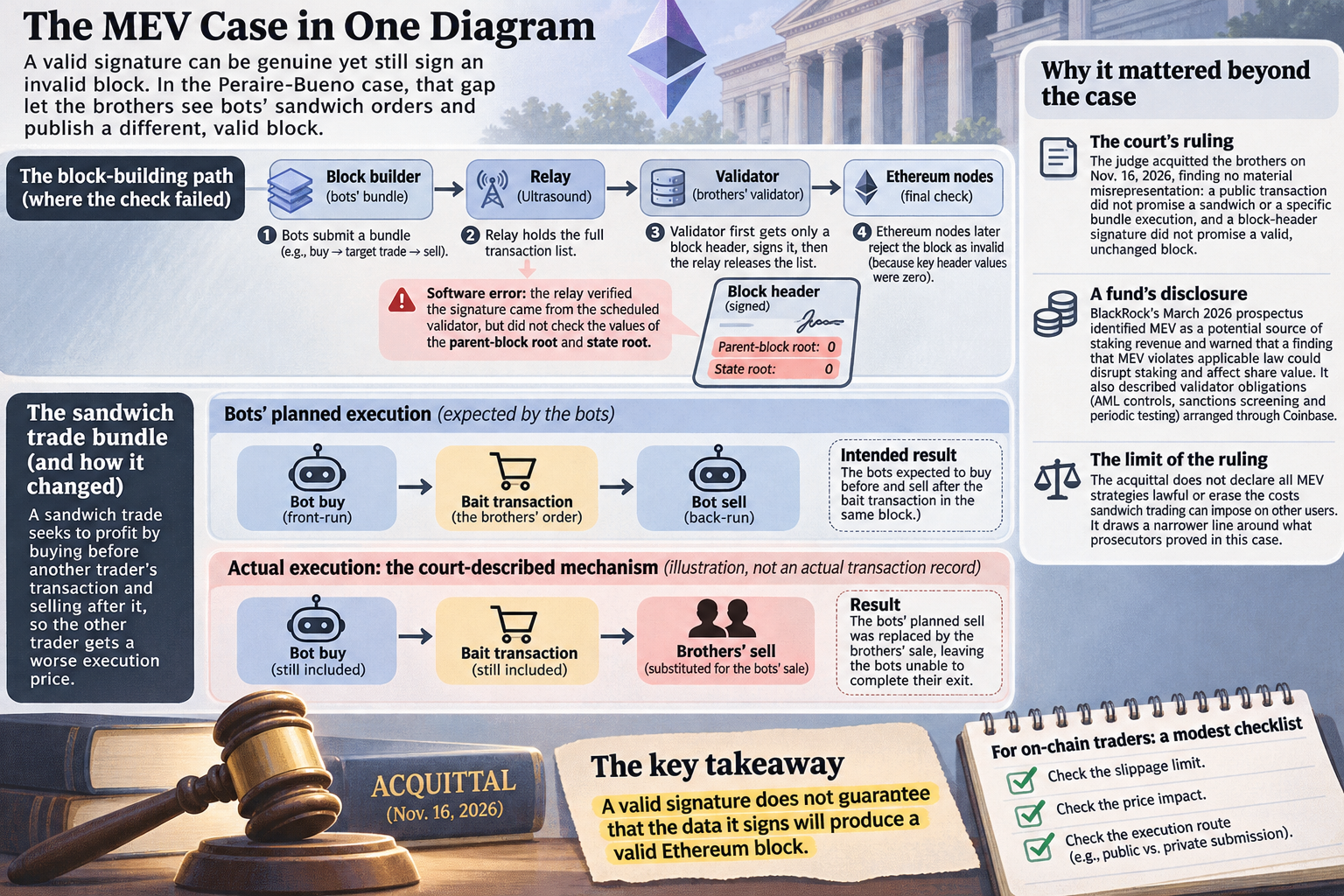
A valid signature does not guarantee that the data it signs will produce a valid Ethereum block. That distinction was central to a U.S. court’s November 16, 2026, acquittal of brothers Anton and James Peraire-Bueno in a case involving trading bots and roughly $25 million, according to prosecutors. For anyone relying on a transaction or a service provider, the practical question is what has actually been checked—and what has merely been assumed.
As reported on November 19, 2026, the case concerned bots seeking maximal extractable value (MEV): value obtained by influencing which transactions enter a block and in what order. MEV covers different activities, but the bots targeted here sought “sandwich” trades. They would buy ahead of another trader’s order and sell afterward, aiming to profit from the price change while the other trader received a worse execution price.
How the relay boundary failed
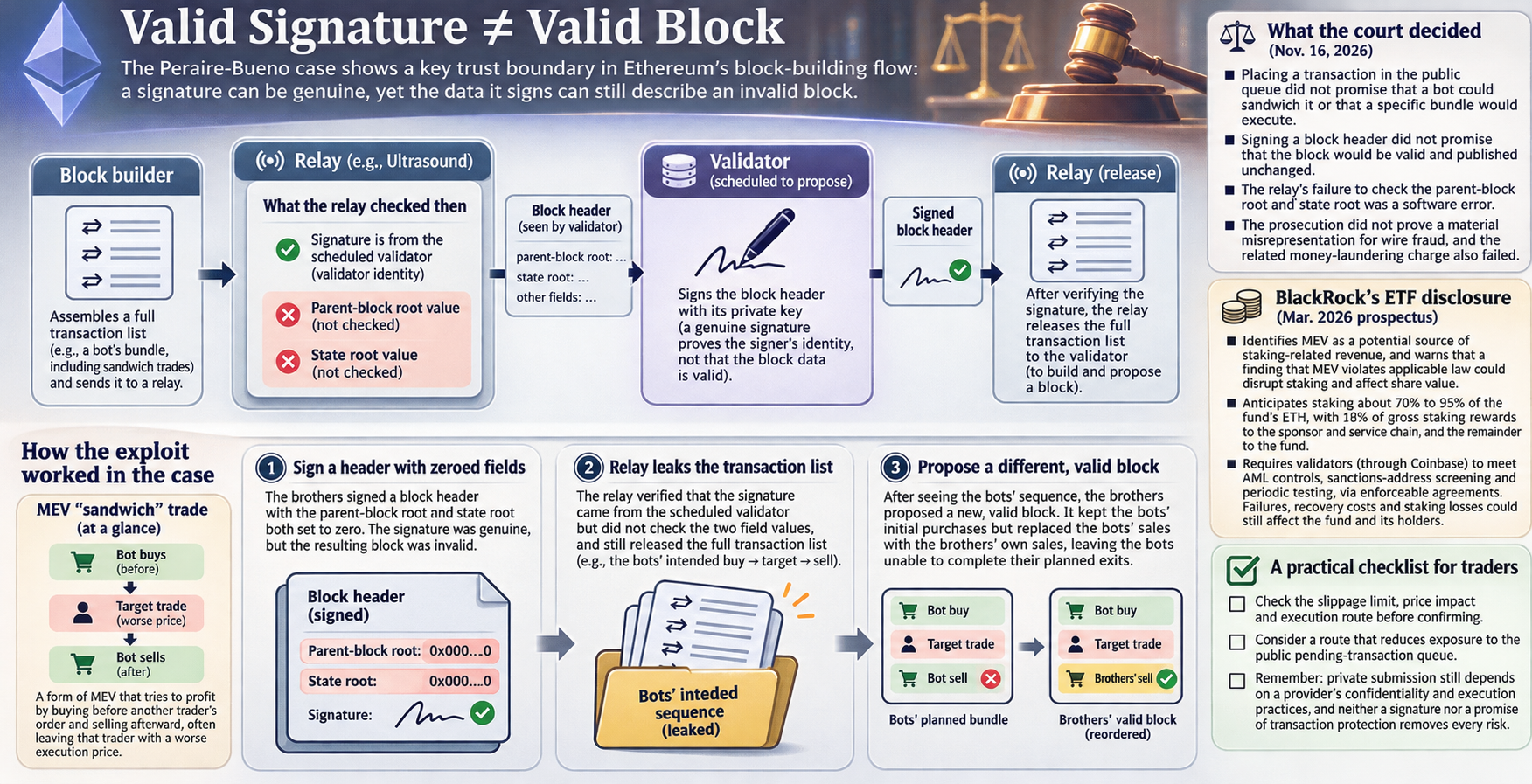
Court records described the brothers studying the bots, setting up 16 validators and testing transactions that might attract them. On April 2, 2023, when a validator they controlled was due to propose a block, they placed eight bait transactions in the public pending-transaction queue. The bots submitted transaction bundles intended to buy before those orders and sell after them.
In the block-building process described in the case, a relay held the full transaction list while the validator initially received only a block header. After the validator signed, the relay released the list. The Ultrasound relay software checked that the signature came from the scheduled validator but, at the time, did not check the values of two critical header fields: the parent-block root and the state root. The brothers signed a header with both fields set to zero. The signature was genuine, but the resulting block was invalid. According to the court record, the relay nevertheless disclosed the transactions before Ethereum nodes rejected it.
Having seen the bots’ intended sequence, the brothers proposed a different, valid block. It retained the bots’ initial purchases but substituted the brothers’ sales, leaving the bots unable to complete their planned exits. The prosecution initially described the operation as taking about 12 seconds and obtaining about $25 million; those are the prosecution’s account and figure, not a separate civil accounting of every loss by the judge.
What the ruling did—and did not—decide
Prosecutors charged the brothers in May 2024 with wire fraud, conspiracy to commit wire fraud and conspiracy to commit money laundering. A nearly four-week trial ended in 2025 without a unanimous jury verdict. Following a trial without a jury, a judge acquitted them on November 16, 2026.
The judge rejected the prosecution’s proposed false promises. Placing a transaction in the public queue did not promise that a bot could sandwich it or that a particular bundle would execute. Nor did signing a block header promise that the block would be valid and published unchanged. The relay operator acknowledged that failing to check the two field values was a software error. The judge found that concealment, use of that defect and later fund transfers did not substitute for the material misrepresentation required for the wire-fraud charges. The money-laundering conspiracy charge in this case depended on proceeds from that alleged fraud.
The acquittal does not declare all MEV strategies lawful or erase the costs sandwich trading can impose on other users. It draws a narrower line around what prosecutors proved in this case.
Why a fund disclosed the risk
BlackRock’s March 2026 prospectus for the iShares Staked Ethereum Trust ETF identified MEV as a potential source of staking-related revenue and warned that a finding that MEV violates applicable law could disrupt staking and affect share value. It anticipated staking roughly 70% to 95% of the fund’s ETH under ordinary circumstances and said the sponsor and service chain together would receive 18% of gross staking rewards, with the remainder retained by the fund. That disclosure does not say the fund ran sandwich bots or participated in this incident.
The prospectus also described contractual obligations for validators arranged through Coinbase, including anti-money-laundering controls, sanctions-address screening and periodic testing. Those obligations illustrate a different trust boundary: software checks, protocol penalties and enforceable agreements do different jobs. The prospectus cautioned that failures by Coinbase or validators, recovery costs and staking losses could still affect the fund and its holders.
For a person making an on-chain trade, the source-supported habit is modest: check the slippage limit, price impact and execution route before confirming. A route that reduces exposure to the public pending-transaction queue may help, but private submission still depends on a provider’s confidentiality and execution practices. Neither a signature nor a promise of transaction protection removes every risk.