For customers keeping assets on an exchange, the share held offline does not tell the whole security story. In a report originally published on November 10, 2026, at 13:05 (UTC+8), cybersecurity firm CertiK argued that exchanges should also set hard dollar limits on what they hold in hot wallets. This was a recommendation, not a new rule.
The question followed disclosures made after the Binance hot-wallet hack. Gate reported that 88.26% of its total assets were in cold storage; Coinbase said it kept more than 99% of customer assets offline. CertiK told Cointelegraph that cold storage helps measure online exposure but is not, by itself, a security score.
Regulatory approaches cited in the report differ: South Korea requires crypto service providers to keep at least 80% of customers’ crypto assets by value in cold storage. Singapore’s guidelines call for at least 90%; Japan’s framework requires at least 95%; and Hong Kong sets a 98% baseline for licensed crypto trading platforms.
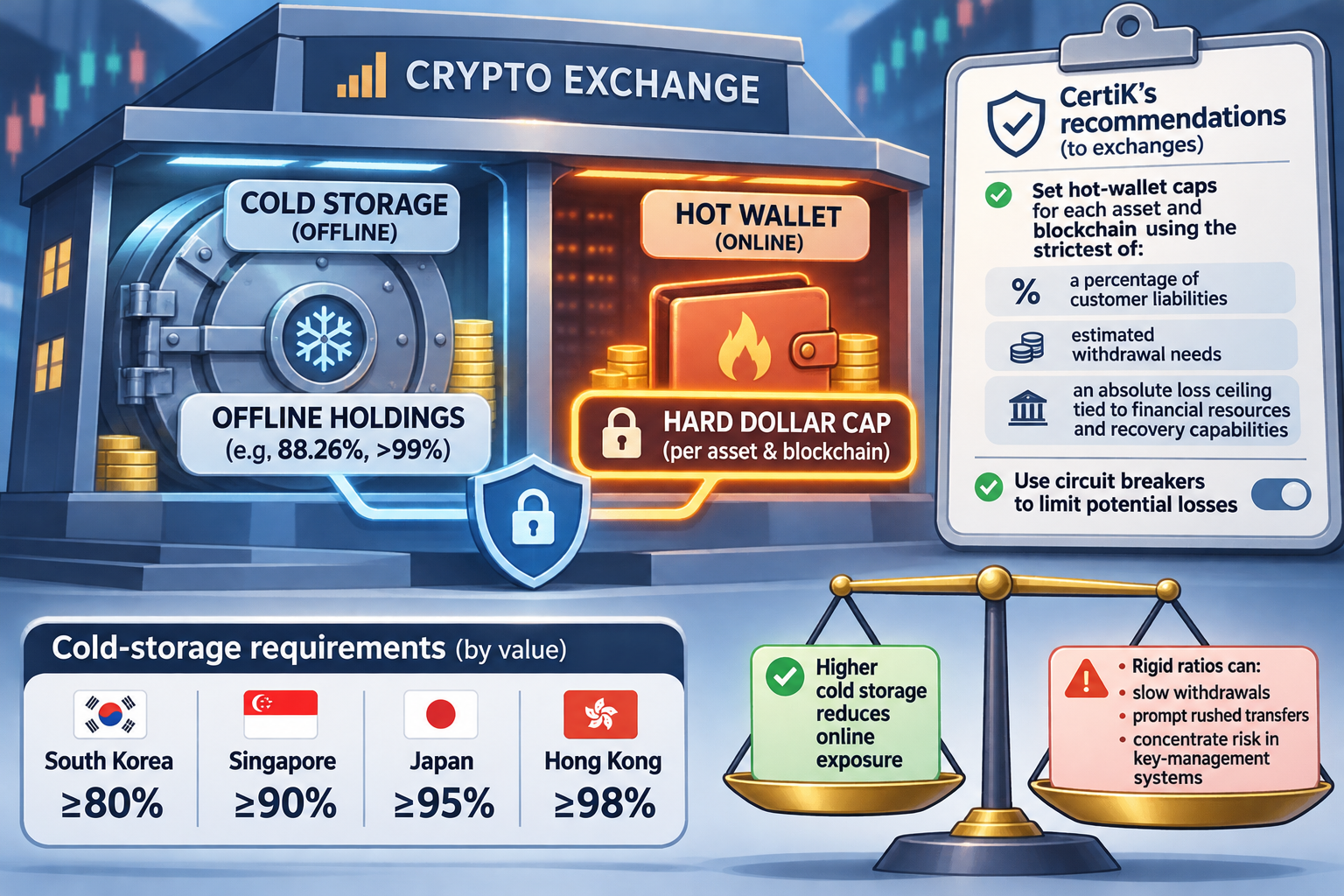
CertiK said higher cold-storage levels generally reduce online exposure, but rigid ratios can slow withdrawals, prompt rushed transfers and concentrate risk in key-management systems. It proposed that exchanges set hot-wallet caps for each asset and blockchain, using the strictest of three limits: a percentage of customer liabilities, estimated withdrawal needs, or an absolute loss ceiling tied to the exchange’s financial resources and recovery capabilities. CertiK also recommended circuit breakers to limit potential losses.
In the same report, Binance said it had replenished approximately 98% of affected tokens after the hack and would absorb the losses. It said the remaining, less-liquid tokens would take longer to acquire. Separately, blockchain analytics firm Elliptic said North Korea-linked hackers had created memecoins to launder stolen funds. Elliptic said it traced roughly $430,000 through six newly launched tokens on NEAR; liquidity pools obscured transfers between wallets, although the transactions remained traceable onchain.
Source: cointelegraph.com (originally published 2026-11-10 13:05 UTC+8)